
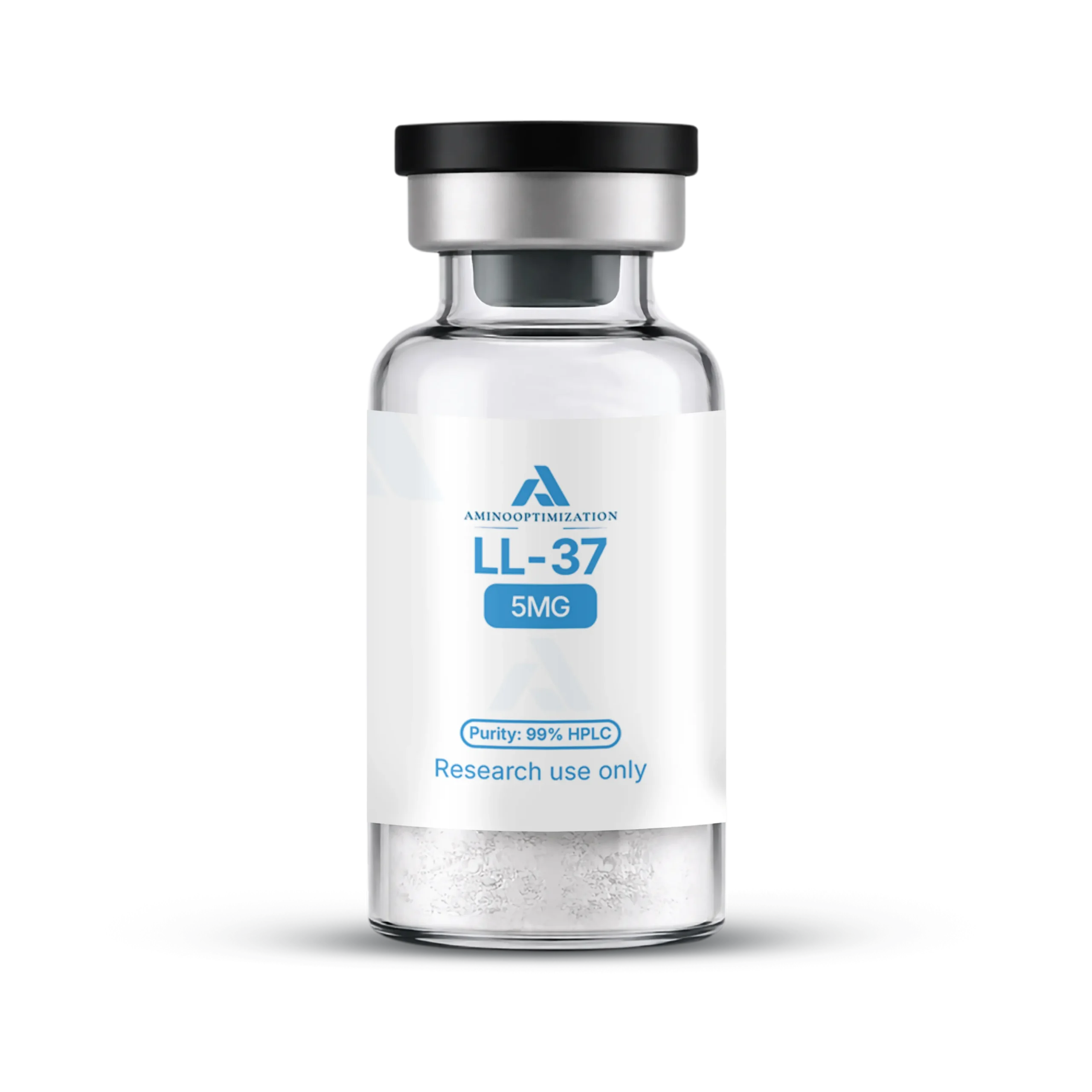
LL-37 is a 37-residue host-defence peptide corresponding to the C-terminal domain of human cathelicidin antimicrobial protein (hCAP18), the only cathelicidin identified in humans and the product of the CAMP gene. AminoOptimization Group supplies it as a lyophilised research powder in a 5 mg presentation, tested to 99% purity by HPLC, with a Certificate of Analysis available for the lot supplied. This material is offered strictly for laboratory research use. It is not a drug, and it is not for human or veterinary use.
What is LL-37?
LL-37 takes its name from the two leucine residues that open its sequence and its length of 37 amino acids. It is generated proteolytically from the C-terminal cathelin-associated domain of hCAP18 by serine proteases, the processing step that liberates the mature peptide from its precursor. Unlike defensin-family peptides, LL-37 is not stabilised by disulfide bonds. In aqueous solution it is largely disordered; its defining architecture, an amphipathic alpha-helix, forms only in the presence of membrane-mimetic environments such as anionic phospholipids, detergent micelles, or bacterial lipopolysaccharide.
It belongs to the cathelicidin family of host-defence peptides, a group that is structurally distinct from the defensins with which it is frequently discussed in the innate-immunity literature. Its net positive charge, arising from multiple lysine and arginine residues distributed across the sequence, together with the inducible amphipathic helix, are the structural features most often cited in biophysical and microbiological study designs examining its membrane-interacting behaviour. LL-37 is also studied as a ligand for formyl peptide receptor-like 1 (FPR2/ALX), a G-protein-coupled receptor implicated in the recruitment of specific leukocyte populations in cell-based assays.
Specifications
- Compound: LL-37
- CAS number: 597562-32-8
- Molecular formula: C205H340N60O53
- Molecular weight: 4493.28 g/mol
- Purity: 99% by HPLC
- Presentation: Lyophilised powder, sealed vial
- Available sizes: 5 mg
- Physical form: White to off-white powder
- Classification: Research peptide — not for human or veterinary use
Research context
Published research on LL-37 spans microbiology, immunology, and dermatological science, generally organised around two lines of inquiry: how the peptide interacts with microbial and host cell membranes, and how it modulates immune signalling independent of direct membrane disruption.
In vitro work has examined LL-37’s activity against a range of Gram-positive and Gram-negative bacterial species, typically attributed to membrane permeabilisation associated with its amphipathic helix and cationic charge. Separately, published research examines how the peptide binds and neutralises bacterial lipopolysaccharide, a property studied in model systems investigating innate immune signalling and endotoxin-driven inflammatory pathways. LL-37 also appears in study designs investigating chemotaxis, where its interaction with the receptor FPR2 is examined for a role in recruiting neutrophils, monocytes, and T lymphocytes in cell-based assays, and in study designs investigating wound-healing responses, where re-epithelialisation and angiogenesis markers are used as endpoints in animal tissue and in vitro models.
None of this literature establishes safety or efficacy for use in humans. It is provided as research context only.
Reconstitution
Lyophilised peptide requires reconstitution with a suitable sterile diluent before use in solution. Bacteriostatic water is the diluent most commonly specified for multi-use laboratory preparations; sterile water is typical for single-use work.
Direct the diluent stream against the inner wall of the vial rather than onto the powder itself, and allow the material to dissolve without agitation. Peptides are susceptible to shear stress — do not shake the vial. Swirl gently if needed, and expect full dissolution within a few minutes at room temperature.
Working concentration is a function of how much diluent is added to a given vial mass. Our peptide reconstitution calculator computes the resulting concentration for any combination of vial size and diluent volume.
Storage and stability
Before reconstitution: store the sealed vial in a freezer at -20 °C, protected from light. Lyophilised peptide is comparatively stable in this state. Brief excursions to ambient temperature during shipping are normal and are not expected to compromise a properly lyophilised product.
After reconstitution: refrigerate at 2–8 °C and protect from light. Reconstituted peptide in solution is materially less stable than the dry powder, and cationic, amphipathic peptides such as this one are prone to surface adsorption and aggregation in dilute solution. Avoid repeated freeze-thaw cycles, which are a well-documented cause of aggregation and loss of measurable potency — aliquot instead if repeated sampling is required.
Inspect solutions before use. Cloudiness, visible particulate, or discolouration indicate the material should not be relied upon for quantitative work.
Certificate of Analysis
Every lot is tested by high-performance liquid chromatography, and the purity figure shown above refers to analytical results for the specific lot supplied — not to a generic specification. A Certificate of Analysis is available on request, and we will provide lot-specific documentation before purchase if your protocol requires it.
Purity by HPLC describes the proportion of the target peptide relative to detectable related substances. It is a statement about the material as manufactured and tested. It is expressly not a representation that the material is suitable for any use in humans or animals.
Handling and safety
Handle in accordance with good laboratory practice. Use appropriate personal protective equipment, work in a suitable containment environment, and dispose of material and consumables according to your institution’s requirements and applicable local regulation. Anyone with access to this material should understand that it is not for human or veterinary use.
Frequently asked questions
Is LL-37 approved in Canada?
No. This compound has not been evaluated or authorised by Health Canada, the FDA, or any comparable regulatory authority. It carries no DIN or NPN, its safety and efficacy for human use have not been assessed, and it is supplied for laboratory research only.
What distinguishes LL-37 from defensin peptides?
Defensins are stabilised by disulfide bonds and adopt a fixed three-dimensional fold. LL-37 has no disulfide bonds and is largely disordered in aqueous solution; its amphipathic helix forms only on contact with a membrane-mimetic surface, which the literature treats as its principal structural determinant.
How much diluent should be used?
That depends on the working concentration your protocol requires. Use the reconstitution calculator to work out the resulting concentration for your vial size.
How stable is LL-37 in solution?
Stability in solution is shorter than in lyophilised form and depends on diluent, temperature, and handling. Refrigerate at 2–8 °C, protect from light, avoid freeze-thaw cycling, and validate stability for your own storage conditions if your work depends on it.
Do you provide a Certificate of Analysis?
Yes — lot-specific, available on request, including before purchase.
Research use only
This product is supplied solely for laboratory and scientific research. It is not a drug, food, cosmetic, or medical device, and it must not be administered to humans or animals. Nothing on this page is medical advice or a therapeutic claim. Full terms are set out in our Research Use Only Disclaimer.
Reviews
There are no reviews yet.