
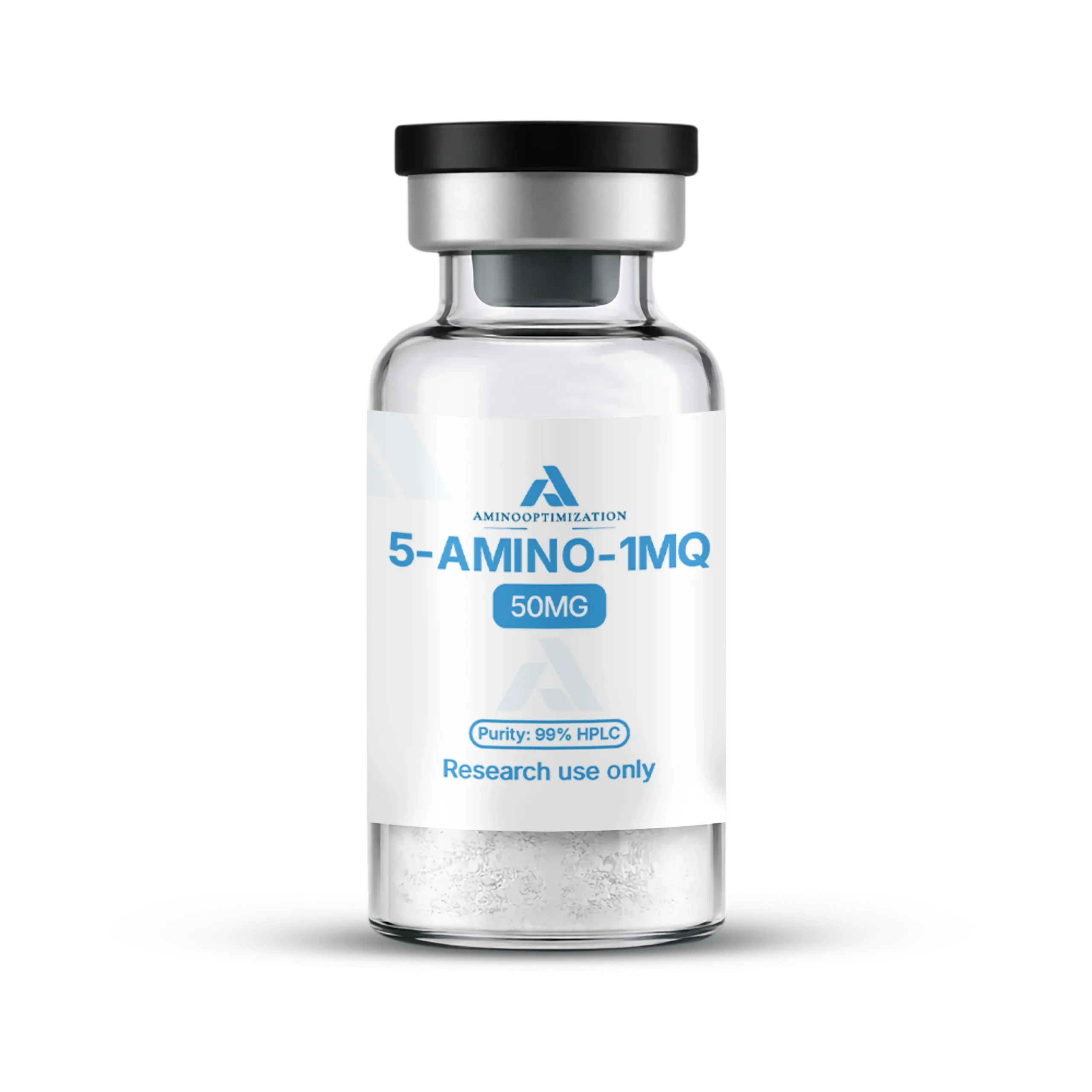
5-Amino-1MQ is a small molecule of the quinolinium class, described in the pharmacology literature as an inhibitor of nicotinamide N-methyltransferase (NNMT). AminoOptimization Group supplies it as a research-grade powder in a 50 mg size, tested to 99% HPLC purity, with a Certificate of Analysis available for the lot supplied. This material is offered strictly for laboratory research use. It is not a drug, and it is not for human or veterinary use.
What is 5-Amino-1MQ?
5-Amino-1MQ is a substituted derivative of 1-methylquinolinium (1MQ), the compound originally identified as a structural analogue of 1-methylnicotinamide — the direct methylated product formed when NNMT acts on nicotinamide. Introducing an amino group onto the quinolinium ring at the 5-position is reported in structure–activity relationship work to increase both potency and selectivity for NNMT’s nicotinamide-binding site relative to the unsubstituted parent compound.
NNMT catalyses the transfer of a methyl group from S-adenosylmethionine (SAM) to nicotinamide, generating 1-methylnicotinamide and S-adenosylhomocysteine (SAH) as products. Because nicotinamide also serves as a substrate for NAD+ salvage synthesis, and because SAM is the principal methyl donor used by many other cellular methyltransferases, this single reaction sits at a point where two distinct metabolic pathways compete for the same substrate pool. That dual dependency is the basis for most of the published interest in NNMT as an enzyme, and in small molecule inhibitors of it as pharmacological tool compounds.
As a small molecule rather than a peptide, 5-Amino-1MQ is prepared by chemical synthesis rather than solid-phase peptide synthesis, and it does not carry the secondary-structure or aggregation considerations relevant to protein handling. It is described in the literature as cell-permeable, a property that supports its use in cultured-cell assay systems designed to interrogate NNMT-dependent signalling without genetic knockdown of the enzyme.
Specifications
- Compound: 5-Amino-1MQ (5-amino-1-methylquinolinium)
- CAS number: 42464-96-0
- Molecular formula: C11H12N2
- Molecular weight: 172.23 g/mol
- Purity: 99% HPLC
- Presentation: Powder, sealed vial
- Available sizes: 50 mg
- Physical form: White to off-white powder
- Classification: Small Molecule — not for human or veterinary use
Research context
Published research on NNMT is framed around its position at the intersection of cellular methylation capacity and NAD+ metabolism. Because nicotinamide can either be salvaged into NAD+ or diverted into 1-methylnicotinamide by NNMT, studies examine how the enzyme’s activity shifts flux between these two pathways in various model systems, and how pharmacological inhibition with tool compounds such as 5-Amino-1MQ affects intracellular SAM, SAH, and NAD+ pool sizes.
NNMT expression is reported to vary across model systems representing different tissue types, including adipocyte differentiation models such as 3T3-L1 cells, hepatocyte-derived cell lines, and fibroblast or stromal cell models. Work using 5-Amino-1MQ as a chemical probe in these systems examines how blocking NNMT’s catalytic activity alters markers associated with differentiation state, lipid handling, or methylation-dependent gene expression within the model in question.
Selectivity studies comparing NNMT inhibition to activity against structurally related methyltransferases are also part of this literature, used to establish that effects observed in a given assay are attributable to NNMT specifically rather than off-target methyltransferase inhibition.
None of this literature establishes safety or efficacy for use in humans. It is provided as research context only.
Reconstitution
5-Amino-1MQ is a small molecule, not a peptide, so preparing a solution is governed by solubility rather than by the folding and shear-sensitivity considerations that apply to proteins. The compound’s quinolinium core carries a permanent positive charge, a feature reported in the literature to support solubility in aqueous buffers; stock solutions in dimethyl sulfoxide (DMSO) are also routinely prepared where an in vitro protocol calls for a non-aqueous vehicle.
When preparing an aqueous solution, add diluent to the vial gradually and swirl gently until the powder is fully dissolved rather than agitating vigorously. Working concentration is a function of powder mass and diluent volume added, and should be calculated to match the requirements of the specific assay or protocol in use.
Storage and stability
Before dissolution: store the sealed vial at -20 °C, protected from light. As a dry powder, the compound is comparatively stable in this state, and brief excursions to ambient temperature during shipping are normal and are not expected to compromise a properly sealed product.
After dissolution: refrigerate at 2–8 °C and protect from light. Solutions are less stable than the dry powder, and repeated freeze-thaw cycling is a documented source of degradation for many small molecules in this class — aliquot instead if repeated sampling is required.
Inspect solutions before use. Precipitation, an unexpected colour change, or visible particulate indicate the material should not be relied upon for quantitative work.
Certificate of Analysis
Every lot is tested by high-performance liquid chromatography, and the purity figure shown above refers to analytical results for the specific lot supplied, not to a generic specification. A Certificate of Analysis is available on request, and we will provide lot-specific documentation before purchase if your protocol requires it.
Purity by HPLC describes the proportion of the target compound relative to detectable related substances in the material as manufactured and tested. It is expressly not a representation that the material is suitable for any use in humans or animals.
Handling and safety
Handle in accordance with good laboratory practice. Use appropriate personal protective equipment, work in a suitable containment environment, and dispose of material and consumables according to your institution’s requirements and applicable local regulation. Anyone with access to this material should understand that it is not for human or veterinary use.
Frequently asked questions
What is the difference between 5-Amino-1MQ and 1MQ?
1MQ (1-methylquinolinium) was the original small molecule identified as a structural mimic of 1-methylnicotinamide, the direct product of the NNMT reaction. Adding an amino substituent to the quinolinium ring, as in 5-Amino-1MQ, is reported in structure–activity relationship studies to substantially increase potency and selectivity at the same binding site.
Is 5-Amino-1MQ approved in Canada?
No. This compound has not been evaluated or authorised by Health Canada, the FDA, or any comparable regulatory authority. It carries no DIN or NPN, its safety and efficacy for human use have not been assessed, and it is supplied for laboratory research only.
Is 5-Amino-1MQ soluble in water?
Its cationic quinolinium structure is reported to support solubility in aqueous buffers, and DMSO stock solutions are also commonly prepared for in vitro work. Actual solubility should be confirmed under the specific buffer and concentration conditions used in your own protocol.
How should 5-Amino-1MQ be stored once dissolved?
Refrigerate at 2–8 °C, protect from light, and avoid repeated freeze-thaw cycling. Aliquot the solution if your protocol requires repeated sampling, and validate stability under your own storage conditions if quantitative work depends on it.
Do you provide a Certificate of Analysis?
Yes — lot-specific, available on request, including before purchase.
Research use only
This product is supplied solely for laboratory and scientific research. It is not a drug, food, cosmetic, or medical device, and it must not be administered to humans or animals. Nothing on this page is medical advice or a therapeutic claim. Full terms are set out in our Research Use Only Disclaimer.
Reviews
There are no reviews yet.