
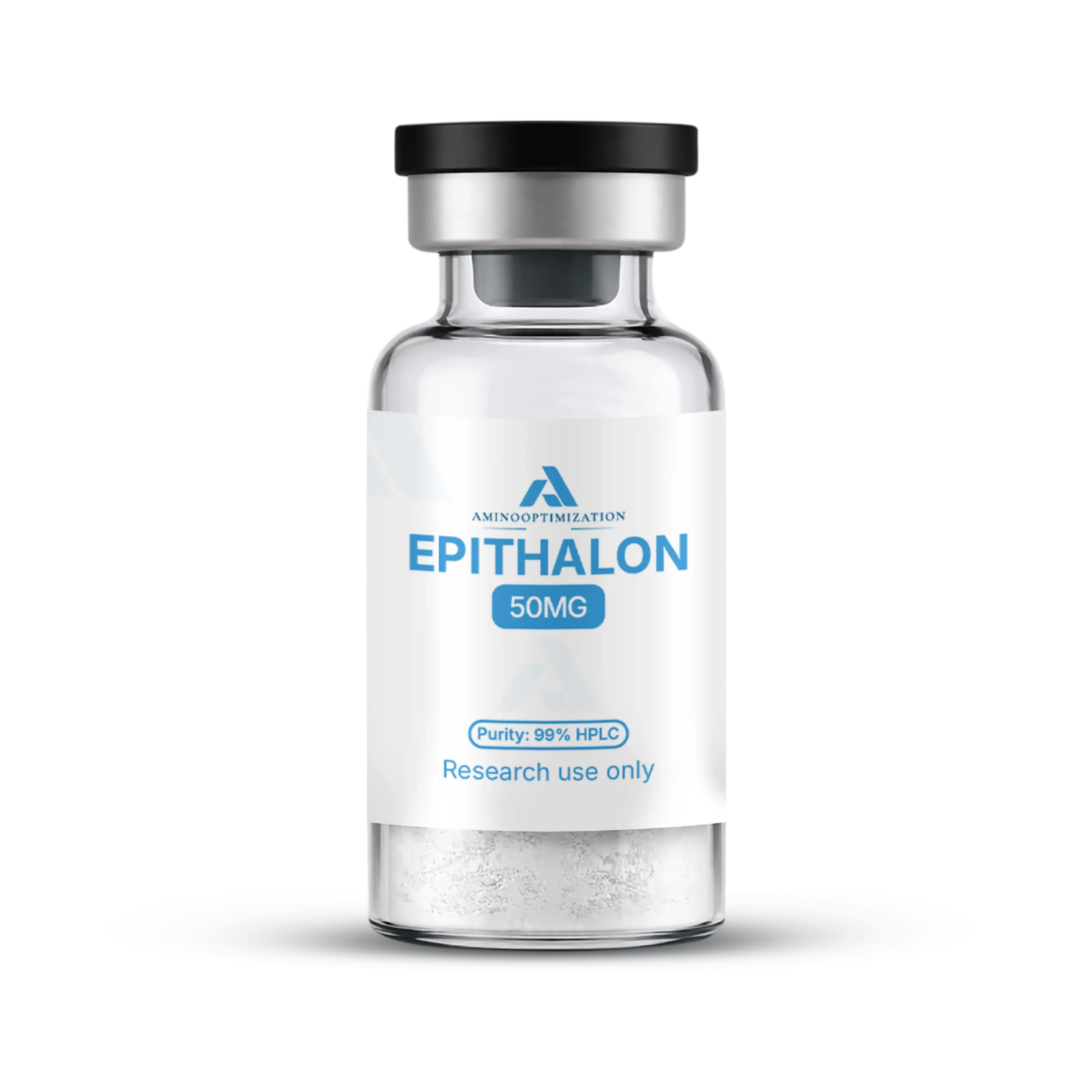
Epithalon is a synthetic tetrapeptide with the amino acid sequence Ala-Glu-Asp-Gly (AEDG), developed as a sequence-defined synthetic analogue of epithalamin, a polypeptide preparation originally isolated from bovine pineal tissue. AminoOptimization Group supplies it as a lyophilised research powder in a 50 mg presentation, tested to 99% purity by HPLC, with a Certificate of Analysis available for the lot supplied. This material is offered strictly for laboratory research use. It is not a drug, and it is not for human or veterinary use.
What is Epithalon?
Epithalon — also written Epitalon in the literature — is one of the smallest peptides in general research use: a linear four-residue chain rather than the multi-loop or double-digit-residue structures typical of most synthetic peptides. At a molecular weight of 390.35 g/mol, it sits closer in scale to a small organic molecule than to a folded protein fragment, and its four residues — alanine, glutamic acid, aspartic acid, and glycine — include two acidic side chains that make the compound freely soluble in aqueous diluents.
The compound originates from a class of substances termed peptide bioregulators, developed through work at the St. Petersburg Institute of Bioregulation and Gerontology on short peptide fractions extracted from mammalian organ tissue. Epithalamin, the tissue-derived precursor material, is a heterogeneous polypeptide extract whose exact composition varies by preparation. Epithalon was synthesised as a defined four-residue sequence identified within that extract, allowing researchers to work with a single, reproducible molecular entity in place of a variable biological mixture — a distinction that matters for any study design requiring consistent material from lot to lot.
Specifications
- Compound: Epithalon (Epitalon) / Ala-Glu-Asp-Gly
- CAS number: 307297-39-8
- Molecular formula: C14H22N4O9
- Molecular weight: 390.35 g/mol
- Purity: 99% by HPLC
- Presentation: Lyophilised powder, sealed vial
- Available sizes: 50 mg
- Physical form: White to off-white powder
- Classification: Research peptide — not for human or veterinary use
Research context
Published literature on this tetrapeptide concentrates on two areas. The first is telomerase activity in cultured cell lines: studies report changes in telomerase expression in cultured human somatic cells exposed to the peptide, and this body of work is frequently cited in cellular senescence and gerontology research examining replicative capacity in vitro. The second is pinealocyte and circadian signalling — investigations into pineal gland function in animal models, including melatonin synthesis pathways and their relationship to age-associated changes in circadian regulation.
The compound also appears in oxidative stress literature, where aged rodent tissue models are used to examine markers of cellular damage alongside peptide exposure. Across all of these lines of investigation, the underlying question is mechanistic: how a short defined peptide sequence interacts with cellular signalling pathways implicated in aging biology, studied in cell culture and animal model systems.
None of this literature establishes safety or efficacy for use in humans. It is provided as research context only.
Reconstitution
Lyophilised peptide requires reconstitution with a suitable sterile diluent before use in solution. Bacteriostatic water is the diluent most commonly specified for multi-use laboratory preparations; sterile water is typical for single-use work.
Direct the diluent stream against the inner wall of the vial rather than onto the powder itself, and allow the material to dissolve without agitation. Peptides are susceptible to shear stress — do not shake the vial. Swirl gently if needed. Given its small size and polar residue content, this tetrapeptide typically goes into solution readily at room temperature.
Working concentration is a function of how much diluent you add to a given vial mass. Our peptide reconstitution calculator computes the resulting concentration for any combination of vial size and diluent volume.
Storage and stability
Before reconstitution: store the sealed vial in a freezer at -20 °C, protected from light. Lyophilised peptide is comparatively stable in this state. Brief excursions to ambient temperature during shipping are normal and are not expected to compromise a properly lyophilised product.
After reconstitution: refrigerate at 2–8 °C and protect from light. Reconstituted peptide in solution is materially less stable than the dry powder. Avoid repeated freeze-thaw cycles, which are a well-documented cause of aggregation and loss of measurable potency — aliquot instead if repeated sampling is required.
Inspect solutions before use. Cloudiness, visible particulate, or discolouration indicate the material should not be relied upon for quantitative work.
Certificate of Analysis
Every lot is tested by high-performance liquid chromatography, and the purity figure shown above refers to analytical results for the specific lot supplied — not to a generic specification. A Certificate of Analysis is available on request, and we will provide lot-specific documentation before purchase if your protocol requires it.
Purity by HPLC describes the proportion of the target peptide relative to detectable related substances. It is a statement about the material as manufactured and tested. It is expressly not a representation that the material is suitable for any use in humans or animals.
Handling and safety
Handle in accordance with good laboratory practice. Use appropriate personal protective equipment, work in a suitable containment environment, and dispose of material and consumables according to your institution’s requirements and applicable local regulation. Anyone with access to this material should understand that it is not for human or veterinary use.
Frequently asked questions
What is the difference between Epithalon and epithalamin?
Epithalamin is a tissue-derived polypeptide extract of variable composition. Epithalon is the synthetic four-residue sequence identified within that extract, manufactured as a single defined compound rather than a mixture, which allows for consistent, reproducible material across lots.
Is Epithalon approved in Canada?
No. This compound has not been evaluated or authorised by Health Canada, the FDA, or any comparable regulatory authority. It carries no DIN or NPN, its safety and efficacy for human use have not been assessed, and it is supplied for laboratory research only.
How much diluent should be used with a 50 mg vial?
That depends on the working concentration your protocol requires. Use the reconstitution calculator to work out the resulting concentration for your vial size.
How long is reconstituted Epithalon stable?
Stability in solution is shorter than in lyophilised form and depends on diluent, temperature, and handling. Refrigerate at 2–8 °C, protect from light, avoid freeze-thaw cycling, and validate stability for your own storage conditions if your work depends on it.
Do you provide a Certificate of Analysis?
Yes — lot-specific, available on request, including before purchase.
Research use only
This product is supplied solely for laboratory and scientific research. It is not a drug, food, cosmetic, or medical device, and it must not be administered to humans or animals. Nothing on this page is medical advice or a therapeutic claim. Full terms are set out in our Research Use Only Disclaimer.
Reviews
There are no reviews yet.