
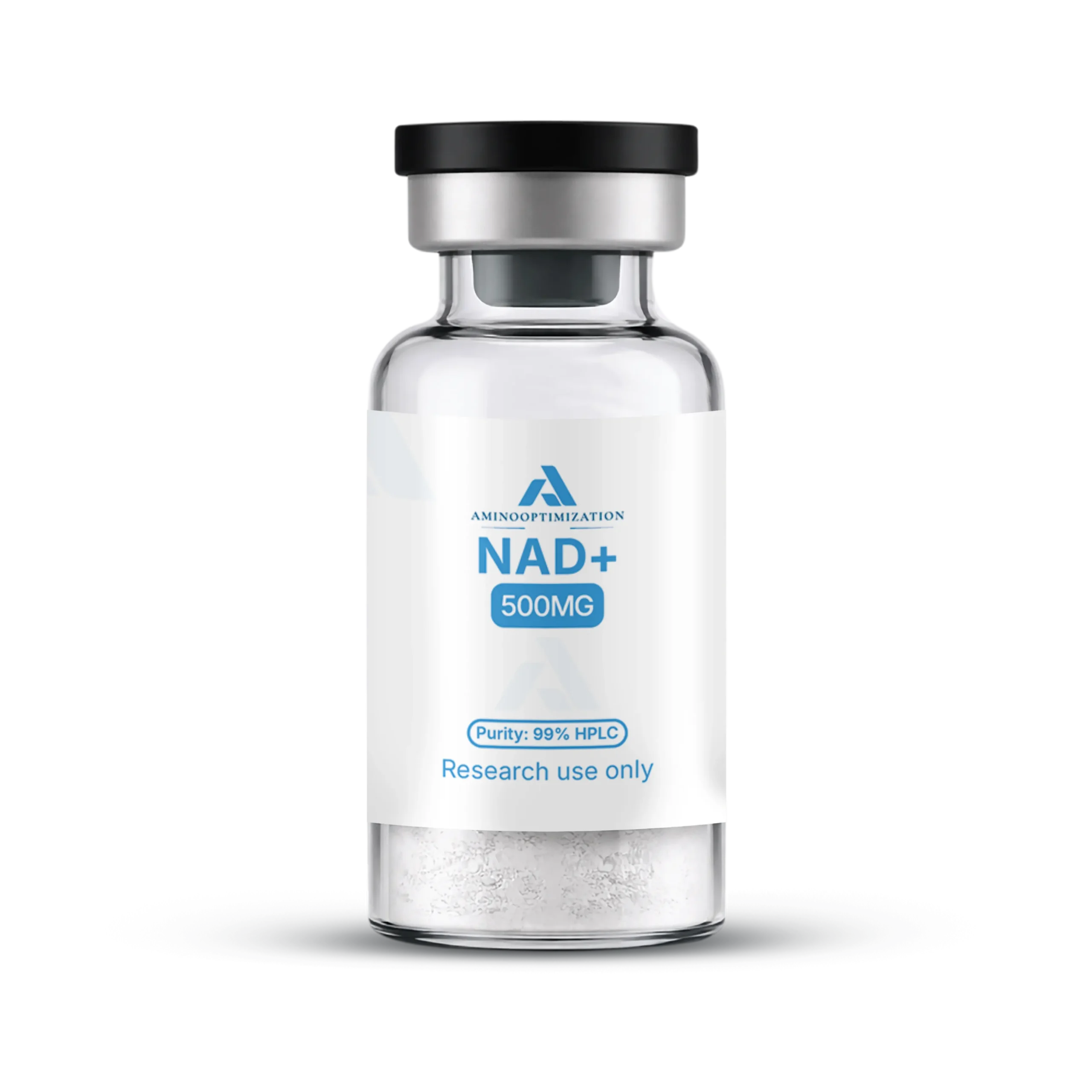
NAD+ (nicotinamide adenine dinucleotide) is a dinucleotide coenzyme found in all living cells, composed of an adenine-containing nucleotide and a nicotinamide-containing nucleotide joined through a pyrophosphate linkage. AminoOptimization Group supplies it as a lyophilised research powder in 500 mg and 1000 mg presentations, tested to 99% purity by HPLC, with a Certificate of Analysis available for the lot supplied. This material is offered strictly for laboratory research use. It is not a drug, and it is not for human or veterinary use.
What is NAD+?
NAD+ is not a peptide. It is a dinucleotide: two nucleotide units, one built on adenine and the other on nicotinamide, linked through the phosphate groups on their ribose sugars. This structure — molecular formula C21H27N7O14P2, molecular weight 663.43 g/mol — places it in the coenzyme class rather than among the amino-acid chains making up the rest of this catalogue.
The molecule exists in an oxidised form (NAD+) and a reduced form (NADH), distinguished chemically by the presence or absence of a hydride ion at the C4 position of the nicotinamide ring — the basis for NAD+’s classical role as an electron carrier in oxidoreductase reactions. A second, mechanistically distinct role is the focus of more recent literature: NAD+ also functions as a consumable co-substrate for enzymes that cleave it outright, releasing nicotinamide and transferring the remaining ADP-ribose moiety onto a substrate. Sirtuins, poly-ADP-ribose polymerases (PARPs), and the CD38/CD157 ADP-ribosyl cyclases are the enzyme families most frequently examined in this context.
NAD+ is also studied alongside its metabolic precursors — nicotinamide mononucleotide (NMN) and nicotinamide riboside (NR) — which are converted to NAD+ intracellularly via the salvage pathway rather than supplying the dinucleotide directly. Because NAD+ itself, its precursors, and its reduced form NADH each enter cellular chemistry at a different point, study designs typically specify which of the three is under investigation rather than treating them as interchangeable.
Specifications
- Compound: NAD+ (Nicotinamide Adenine Dinucleotide)
- CAS number: 53-84-9
- Molecular formula: C21H27N7O14P2
- Molecular weight: 663.43 g/mol
- Purity: 99% by HPLC
- Presentation: Lyophilised powder, sealed vial
- Available sizes: 500 mg, 1000 mg
- Physical form: White to off-white powder
- Classification: Research coenzyme — not for human or veterinary use
Research context
Published research on NAD+ centres on its consumption by sirtuins, PARPs, and CD38 rather than solely on its redox chemistry. Study designs examine how each enzyme family uses NAD+ as a co-substrate — sirtuins in deacetylation reactions, PARPs in adding ADP-ribose polymers to nuclear proteins following DNA strand breaks, and CD38 as a glycohydrolase that degrades NAD+ both extracellularly and intracellularly. Because each reaction destroys a molecule of NAD+ rather than regenerating it, cellular NAD+ concentration is treated in the literature as a quantity that changes with enzyme activity and can be manipulated experimentally.
Exogenous NAD+ and its precursors are used in model systems — cultured cells and animal models — to raise or restore intracellular NAD+ levels and observe the resulting change in sirtuin or PARP activity. The NAD+/NADH ratio is also used as an experimental readout of cellular redox state, independent of any enzyme-consumption pathway.
None of this literature establishes safety or efficacy for use in humans. It is provided as research context only.
Reconstitution
Lyophilised NAD+ requires reconstitution with a suitable sterile diluent before use in solution. Bacteriostatic water is the diluent most commonly specified for multi-use laboratory preparations; sterile water is typical for single-use work.
Direct the diluent stream against the inner wall of the vial rather than onto the powder itself, and allow the material to dissolve without agitation. Swirl gently rather than shaking, and expect full dissolution within a few minutes at room temperature. NAD+ solutions are also light-sensitive; work under subdued lighting where practical.
Working concentration is a function of how much diluent is added to a given vial mass. Our peptide reconstitution calculator computes the resulting concentration for any combination of vial size and diluent volume.
Storage and stability
Before reconstitution: store the sealed vial in a freezer at -20 °C, protected from light. Lyophilised NAD+ is comparatively stable in this state. Brief excursions to ambient temperature during shipping are normal and are not expected to compromise a properly lyophilised product.
After reconstitution: refrigerate at 2–8 °C, protect from light, and use promptly. NAD+ in solution is markedly less stable than the dry powder — it is subject to hydrolytic degradation, a process that accelerates with warmer temperatures, light exposure, and repeated freeze-thaw cycling. Aliquot on reconstitution if repeated sampling is required.
Inspect solutions before use. Cloudiness, visible particulate, or discolouration indicate the material should not be relied upon for quantitative work.
Certificate of Analysis
Every lot is tested by high-performance liquid chromatography, and the purity figure shown above refers to analytical results for the specific lot supplied — not to a generic specification. A Certificate of Analysis is available on request, and we will provide lot-specific documentation before purchase if your protocol requires it.
Purity by HPLC describes the proportion of the target molecule relative to detectable related substances. It is a statement about the material as manufactured and tested. It is expressly not a representation that the material is suitable for any use in humans or animals.
Handling and safety
Handle in accordance with good laboratory practice. Use appropriate personal protective equipment, work in a suitable containment environment, and dispose of material and consumables according to your institution’s requirements and applicable local regulation. Anyone with access to this material should understand that it is not for human or veterinary use.
Frequently asked questions
What is the difference between NAD+ and NADH?
NAD+ is the oxidised form of the dinucleotide; NADH is its reduced form, carrying an additional hydride ion at the C4 position of the nicotinamide ring. The two interconvert in oxidoreductase reactions, and published research frequently reports the NAD+/NADH ratio rather than either concentration alone, since the ratio is what indicates cellular redox state.
Is NAD+ approved in Canada?
No. NAD+ as supplied here has not been evaluated or authorised by Health Canada, the FDA, or any comparable regulatory authority. It carries no DIN or NPN, its safety and efficacy for human use have not been assessed, and it is supplied for laboratory research only.
How much diluent should be used?
That depends on the working concentration your protocol requires. Use the reconstitution calculator to work out the resulting concentration for your vial size.
How long is reconstituted NAD+ usable?
Stability in solution is shorter than in lyophilised form and is sensitive to temperature, light, and pH. Refrigerate at 2–8 °C, protect from light, avoid freeze-thaw cycling, and validate stability for your own storage conditions and timeline if your work depends on it.
Do you provide a Certificate of Analysis?
Yes — lot-specific, available on request, including before purchase.
Research use only
This product is supplied solely for laboratory and scientific research. It is not a drug, food, cosmetic, or medical device, and it must not be administered to humans or animals. Nothing on this page is medical advice or a therapeutic claim. Full terms are set out in our Research Use Only Disclaimer.
Reviews
There are no reviews yet.