
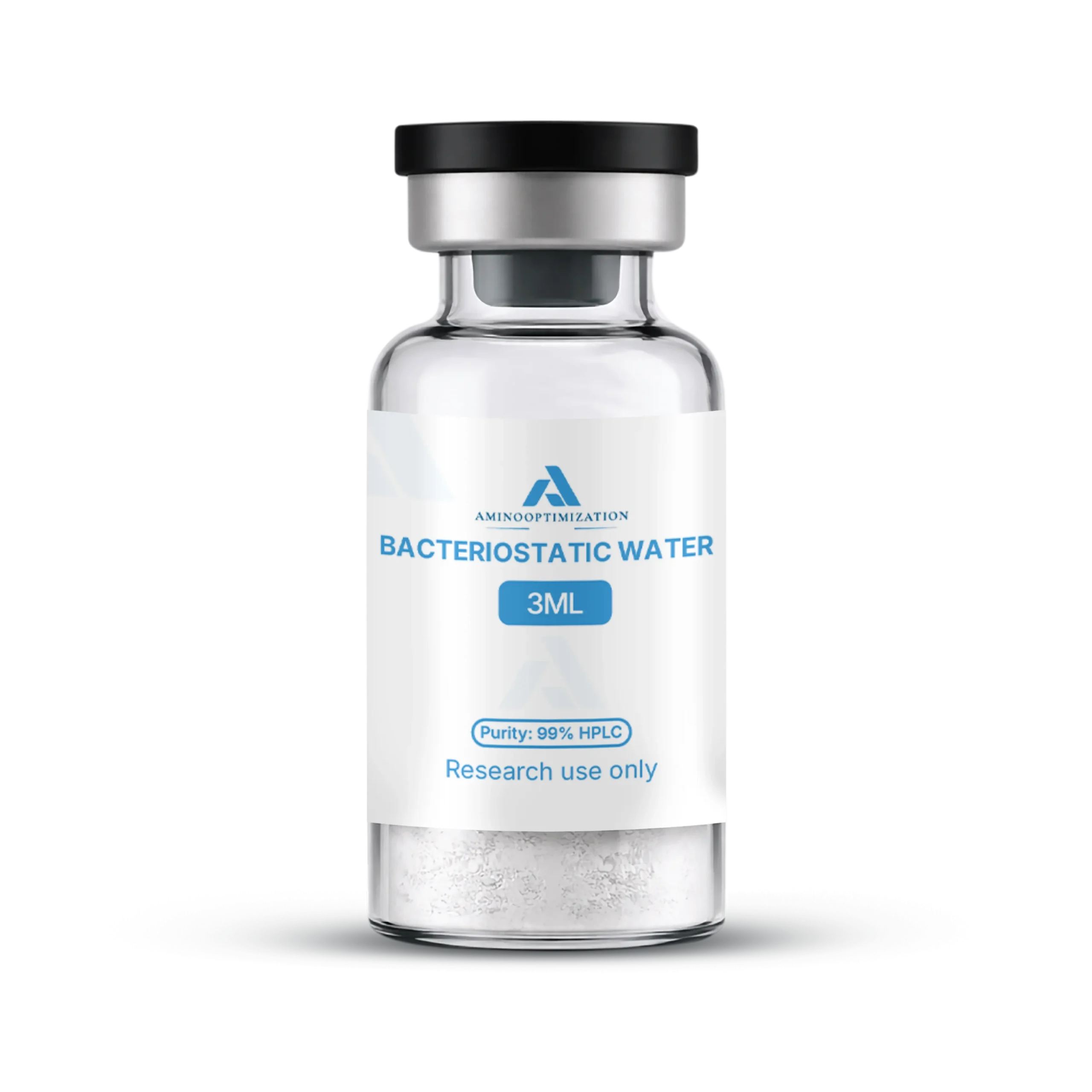
Bacteriostatic water is sterile water for injection formulated with 0.9% benzyl alcohol as an antimicrobial preservative, which is what separates it from plain sterile water and permits safe multiple withdrawals from a single sealed vial. AminoOptimization Group supplies it as a ready-to-use liquid diluent in 3 mL, 10 mL and 30 mL vials, manufactured to USP grade, with a Certificate of Analysis available for the lot supplied. This material is offered strictly for laboratory research use. It is not a drug, and it is not for human or veterinary use.
What is bacteriostatic water?
Bacteriostatic water is water meeting United States Pharmacopeia purity and sterility standards, to which benzyl alcohol has been added at 0.9% w/v. Benzyl alcohol at this concentration is bacteriostatic rather than bactericidal — it inhibits the growth and reproduction of bacteria that may be introduced into the vial rather than eliminating microorganisms already present on contact. That distinction is the reason for the name and the reason the preparation behaves differently from unpreserved water once a vial has been opened.
Sterile water for injection carries no preservative. Once its seal is broken, sterility can no longer be assured for any period afterward, so pharmacopeial guidance treats it as single-withdrawal only. Adding benzyl alcohol changes that: the preservative suppresses microbial growth between successive needle entries, which is why bacteriostatic water is the article specified for vials that a protocol expects to be entered more than once, and why it is designated USP grade rather than sold as a bulk industrial solvent.
In a laboratory setting, this is the practical reason bacteriostatic water is the diluent most often paired with lyophilised research peptides supplied in multi-aliquot vials: reconstituting into a preserved diluent lets a single reconstituted vial be drawn from repeatedly across a study rather than discarded after one use, provided aseptic technique is maintained at each draw.
Specifications
- Compound: Bacteriostatic Water
- CAS number: N/A — a preserved aqueous preparation, not a single chemical entity
- Molecular formula: H2O + 0.9% Benzyl Alcohol
- Molecular weight: N/A
- Purity: USP Grade
- Presentation: Sterile aqueous solution, sealed vial
- Available sizes: 3ML / 10ML / 30ML
- Physical form: Clear, colourless liquid
- Classification: Diluent — not for human or veterinary use
Reconstitution
When used to reconstitute lyophilised peptide research material, direct the stream of water against the inner wall of the receiving vial rather than onto the powder itself, and let the material dissolve without agitation. Peptides are susceptible to shear stress, so do not shake the vial; swirl gently if needed, and expect full dissolution within a few minutes at room temperature.
Working concentration is a function of how much diluent is added to a given vial mass, and the 3 mL, 10 mL and 30 mL sizes exist to cover different vial masses and dilution schemes. Our peptide reconstitution calculator computes the resulting concentration for any combination of vial size and diluent volume, and can help decide which size best matches a given protocol.
Storage and stability
Before first use: store sealed vials at room temperature, away from direct light and excessive heat. This preparation does not require freezer storage the way a lyophilised peptide does — it is a stable aqueous solution, not a dried protein, and does not need protection from ambient temperature the way dry powder does.
After first puncture: the benzyl alcohol preservative is what allows a vial to be returned to for multiple withdrawals rather than treated as single-use, but that capacity is not indefinite. Continue to store the opened vial at room temperature, swab the stopper before each draw, and apply your own protocol’s limit on how long a multi-dose vial remains valid after first puncture rather than assuming indefinite use. Discard any vial that shows cloudiness, visible particulate, or discolouration regardless of how long it has been open.
Certificate of Analysis
Each lot is tested against USP grade specification for this article, and a Certificate of Analysis is available on request, including before purchase, for the specific lot supplied. A USP grade designation describes the water and preservative as manufactured and tested against compendial quality standards. It is expressly not a representation that the material is suitable for any use in humans or animals.
Handling and safety
Handle in accordance with good laboratory practice. Use appropriate personal protective equipment when opening a vial or drawing from it, work in a suitable containment environment, and dispose of vials and consumables according to your institution’s requirements and applicable local regulation. Benzyl alcohol can irritate eyes and skin at the concentration used here — avoid direct contact and consult the safety data sheet for full handling guidance. Anyone with access to this material should understand that it is not for human or veterinary use.
Frequently asked questions
What is the difference between bacteriostatic water and sterile water for injection?
Sterile water for injection contains no preservative and is treated as single-withdrawal, since sterility cannot be assured for any period once its seal is broken. Bacteriostatic water contains 0.9% benzyl alcohol, which inhibits bacterial growth between draws and is the reason it is specified for vials a protocol expects to enter more than once.
Is bacteriostatic water approved in Canada?
No. This product has not been evaluated or authorised by Health Canada, the FDA, or any comparable regulatory authority. It carries no DIN or NPN, its safety and efficacy for human use have not been assessed, and it is supplied for laboratory research only.
How many times can a vial be used?
The preservative is what makes repeated withdrawal possible in principle, but the practical number of draws depends on vial size, volume withdrawn per use, and how strictly aseptic technique is maintained at each entry. Follow your own protocol’s limit rather than assuming indefinite use.
Why does bacteriostatic water use benzyl alcohol specifically?
Benzyl alcohol at 0.9% is the concentration set out in the USP monograph for this article. It is effective against a broad range of bacteria at that concentration while remaining compatible with aqueous solutions used as diluents, which is why it is the standard preservative for this preparation rather than an incidental additive.
Do you provide a Certificate of Analysis?
Yes — lot-specific, available on request, including before purchase.
Research use only
This product is supplied solely for laboratory and scientific research. It is not a drug, food, cosmetic, or medical device, and it must not be administered to humans or animals. Nothing on this page is medical advice or a therapeutic claim. Full terms are set out in our Research Use Only Disclaimer.
Reviews
There are no reviews yet.