
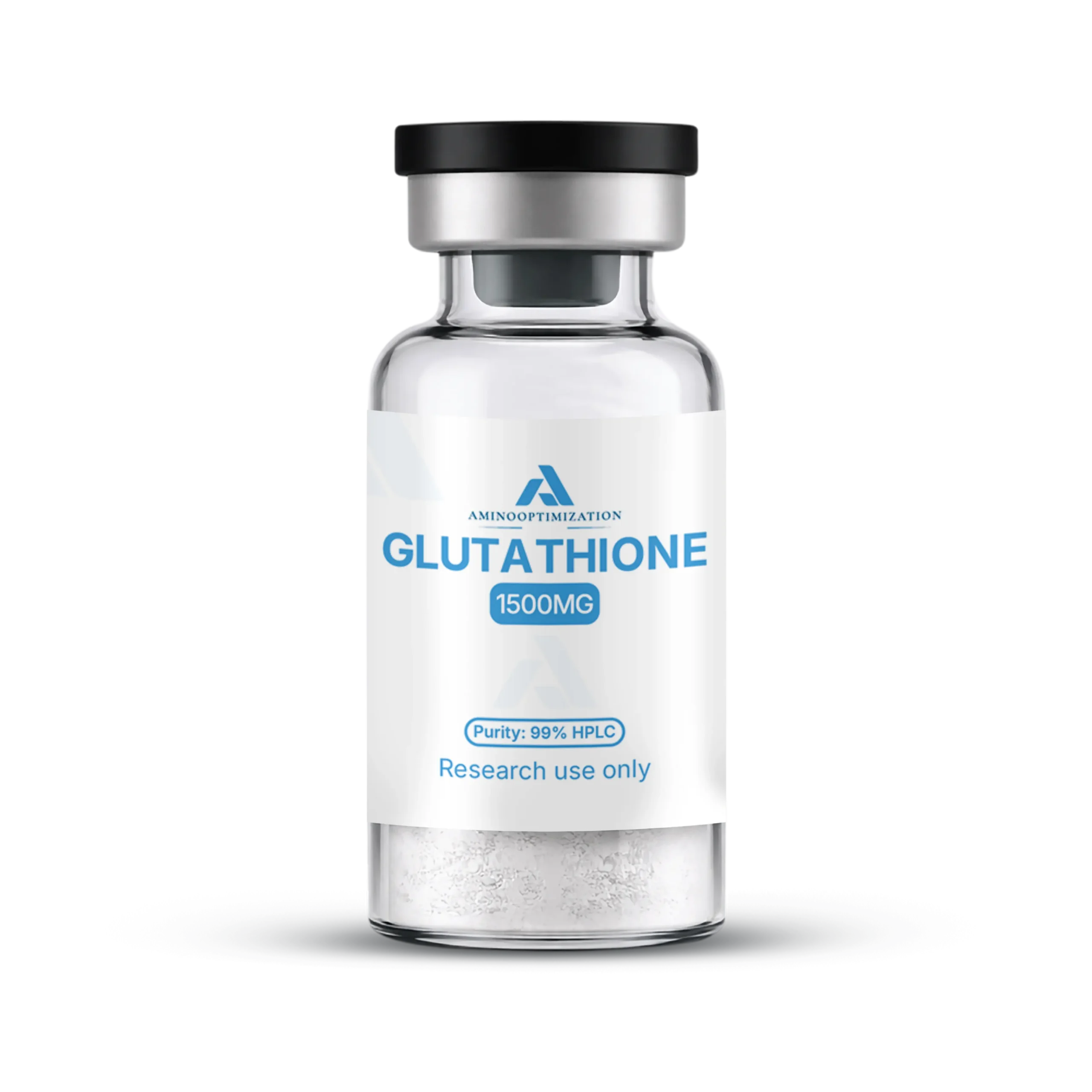
Glutathione is a low-molecular-weight tripeptide formed from L-glutamate, L-cysteine, and glycine, and is the most abundant low-molecular-weight thiol compound found in mammalian cells. AminoOptimization Group supplies it as a lyophilised research powder in a 1500 mg presentation, tested to 99% purity by HPLC, with a Certificate of Analysis available for the lot supplied. This material is offered strictly for laboratory research use. It is not a drug, and it is not for human or veterinary use.
What is glutathione?
Glutathione (γ-L-glutamyl-L-cysteinylglycine) departs from a standard tripeptide in the bond joining its first two residues. Glutamate is linked to cysteine through the gamma-carboxyl group on the glutamate side chain, rather than the alpha-carboxyl group used in conventional peptide bond formation. This gamma-glutamyl linkage defines the molecule and is why it is largely resistant to cleavage by ordinary aminopeptidases and exopeptidases, which recognise only alpha-peptide bonds. Only a small number of enzymes — principally gamma-glutamyl transpeptidase — are capable of hydrolysing it.
The functionally reactive part of the molecule is the free thiol (-SH) group contributed by the cysteine residue. This thiol underlies glutathione’s role as a redox couple: two molecules of the reduced form (GSH) can be oxidised to form a single molecule of glutathione disulfide (GSSG), joined by a disulfide bridge between the two cysteine residues. Interconversion between GSH and GSSG, and their ratio, is what makes the molecule a standard tool in redox biochemistry for characterising the oxidative state of a system under study.
Biosynthesis proceeds through two ATP-dependent enzymatic steps: glutamate-cysteine ligase forms the gamma-glutamylcysteine dipeptide, and glutathione synthetase adds the terminal glycine residue. Both steps, along with the downstream enzymes that oxidise, reduce, and conjugate the resulting tripeptide, are frequently modelled in isolation in vitro to examine discrete segments of the pathway.
Specifications
- Compound: Glutathione (reduced, GSH)
- CAS number: 70-18-8
- Molecular formula: C10H17N3O6S
- Molecular weight: 307.33 g/mol
- Purity: 99% HPLC
- Presentation: Lyophilised powder, sealed vial
- Available sizes: 1500 mg
- Physical form: White to off-white powder
- Classification: Antioxidant — research compound, not for human or veterinary use
Research context
Published biochemical literature on glutathione centres on its function as the principal intracellular redox buffer. Work in cell-free systems and cultured cell models examines how the GSH/GSSG ratio shifts under induced oxidative stress, and how the enzymes that maintain that ratio operate: glutathione peroxidase, which uses GSH to reduce hydrogen peroxide and lipid hydroperoxides, and glutathione reductase, which regenerates GSH from GSSG using NADPH as an electron donor.
A separate body of work examines glutathione as a substrate in phase II xenobiotic metabolism, where glutathione S-transferase enzymes catalyse conjugation of its thiol group to electrophilic compounds — a reaction studied in liver homogenate and microsomal model systems to characterise the metabolic fate of test substances. Pharmacological depletion of glutathione in these same systems is a standard tool for probing the consequences of reduced cellular redox capacity.
None of this literature establishes safety or efficacy for use in humans. It is provided as research context only.
Reconstitution
Lyophilised glutathione requires reconstitution with a suitable sterile diluent before use in solution. Bacteriostatic water is the diluent most commonly specified for multi-use laboratory preparations; sterile water is typical for single-use work.
Direct the diluent stream against the inner wall of the vial rather than onto the powder itself, and allow the material to dissolve without agitation. Do not shake the vial: beyond the shear stress this introduces, agitation increases exposure to dissolved oxygen, which can drive oxidation of the free thiol toward the disulfide (GSSG) form. Swirl gently if needed, and expect full dissolution within a few minutes at room temperature.
Working concentration is a function of how much diluent is added to a given vial mass. Our peptide reconstitution calculator computes the resulting concentration for any combination of vial size and diluent volume.
Storage and stability
Before reconstitution: store the sealed vial in a freezer at -20 °C, protected from light. Lyophilised material in this state is comparatively stable. Brief excursions to ambient temperature during shipping are normal and are not expected to compromise a properly lyophilised product.
After reconstitution: refrigerate at 2–8 °C and protect from light. Glutathione in solution is materially less stable than the dry powder, in part because the free thiol group is prone to gradual air oxidation. Avoid repeated freeze-thaw cycles, and aliquot instead if repeated sampling is required.
Inspect solutions before use. Cloudiness, visible particulate, or discolouration indicate the material should not be relied upon for quantitative work.
Certificate of Analysis
Every lot is tested by high-performance liquid chromatography, and the purity figure above refers to analytical results for the specific lot supplied — not a generic specification. A Certificate of Analysis is available on request, including before purchase if your protocol requires it.
Purity by HPLC describes the proportion of the target compound relative to detectable related substances. It is a statement about the material as manufactured and tested. It is expressly not a representation that the material is suitable for any use in humans or animals.
Handling and safety
Handle in accordance with good laboratory practice. Use appropriate personal protective equipment, work in a suitable containment environment, and dispose of material and consumables according to your institution’s requirements and applicable local regulation. This material is not for human or veterinary use.
Frequently asked questions
Is glutathione approved in Canada?
No. This compound has not been evaluated or authorised by Health Canada, the FDA, or any comparable regulatory authority for any indication. It carries no Health Canada Drug Identification Number (DIN) or Natural Product Number (NPN), and its safety and efficacy for human use have not been established through the regulatory review such approval requires. It is supplied exclusively for laboratory research, and no human-use claim made about this class of compound elsewhere applies to this listing.
What is the difference between reduced glutathione (GSH) and glutathione disulfide (GSSG)?
GSH is the reduced, monomeric form, carrying a free thiol group on its cysteine residue. Under oxidising conditions, two GSH molecules can form a disulfide bond, producing GSSG, the oxidised dimer. The ratio between these two forms is a standard marker of redox state in cell-free and cell culture model systems.
How much diluent should be used?
That depends on the working concentration your protocol requires. Use the reconstitution calculator to work out the resulting concentration for your vial size.
How long is reconstituted material usable?
Stability in solution is shorter than in lyophilised form and depends on diluent, temperature, and handling, and is further limited by the tendency of the free thiol group to oxidise over time. Refrigerate at 2–8 °C, protect from light, avoid freeze-thaw cycling, and validate stability for your own storage conditions if your work depends on it.
Do you provide a Certificate of Analysis?
Yes — lot-specific, available on request, including before purchase.
Research use only
This product is supplied solely for laboratory and scientific research. It is not a drug, food, cosmetic, or medical device, and it must not be administered to humans or animals. Nothing on this page is medical advice or a therapeutic claim. Full terms are set out in our Research Use Only Disclaimer.
Reviews
There are no reviews yet.