
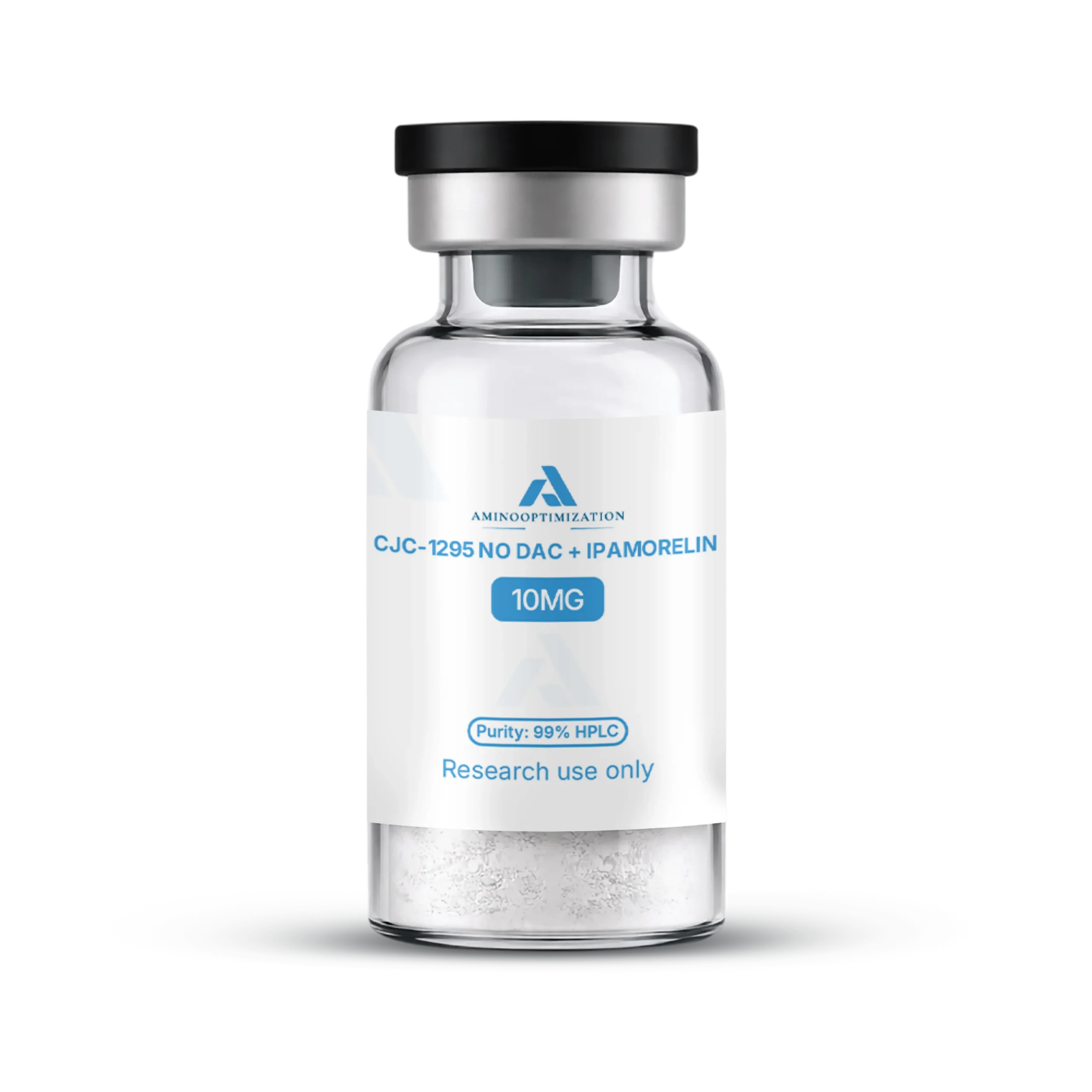
CJC-1295 (No DAC) + Ipamorelin is a two-component research blend pairing a growth-hormone-releasing hormone (GHRH) analogue with a growth hormone secretagogue receptor (GHS-R) agonist. AminoOptimization Group supplies it as a lyophilised research powder in a 10 mg vial, tested to 99% purity by HPLC, with a Certificate of Analysis available for the lot supplied. This material is offered strictly for laboratory research use. It is not a drug, and it is not for human or veterinary use.
What is CJC-1295 (No DAC) + Ipamorelin?
This product combines two peptides acting on separate receptors within the somatotropic axis, rather than a single compound. Because it is a blend, it carries no single CAS number, molecular formula or molecular weight — those fields are listed as not applicable below. Each component’s identity is described separately.
CJC-1295 (No DAC), also called Modified GRF (1-29) in the literature, is a synthetic analogue of the first 29 amino acids of endogenous growth-hormone-releasing hormone — the fragment identified as the minimum sequence retaining receptor activity. “No DAC” means it lacks the Drug Affinity Complex, a group that in the DAC-conjugated form binds covalently to serum albumin and extends circulating half-life. Without it, this analogue clears much faster, producing a shorter, sharper signal at the GHRH receptor rather than a sustained one.
Ipamorelin is a synthetic pentapeptide — five amino acids — classified as a growth hormone secretagogue. It acts at the growth hormone secretagogue receptor (GHS-R1a), the receptor family targeted by endogenous ghrelin, distinct from the GHRH receptor CJC-1295 (No DAC) engages. Because the two act through separate pathways, researchers often examine them together to probe how concurrent stimulation compares with either pathway alone.
Specifications
- Compound: CJC-1295 (No DAC) + Ipamorelin (blend)
- CAS number: N/A (blend)
- Molecular formula: N/A (blend)
- Molecular weight: N/A (blend)
- Purity: 99% HPLC
- Presentation: Lyophilised powder, sealed vial
- Available sizes: 10 mg
- Physical form: White to off-white powder
- Classification: Research peptide blend — not for human or veterinary use
Research context
GHRH analogues and GHS-R agonists are studied as two distinct arms of growth hormone secretagogue research. Published work on CJC-1295 (No DAC) examines how GHRH receptor agonism at the anterior pituitary influences downstream signalling, with attention to how signal frequency and amplitude — rather than mere presence — shape the response observed in model systems. Because the No DAC variant clears quickly, it appears in study designs investigating pulsatility: whether a short, sharp signal differs in effect from the prolonged elevation associated with albumin-bound analogues.
Ipamorelin’s literature focuses heavily on receptor selectivity. Study designs compare its binding at GHS-R1a against earlier-generation secretagogues, and a recurring theme is a more restricted secondary hormone profile — less pronounced concurrent release of adrenocorticotropic hormone, cortisol and prolactin relative to broader-spectrum growth hormone releasing peptides. This selectivity is cited as one reason the compound is examined as a comparatively “clean” GHS-R ligand in receptor-binding assays.
Combination study designs pair the two because they act on non-overlapping receptors, and researchers use such pairings to investigate whether simultaneous GHRH-receptor and GHS-R agonism produces additive or synergistic signalling relative to either compound alone in a model system. None of this literature establishes safety or efficacy for use in humans. It is provided as research context only.
Reconstitution
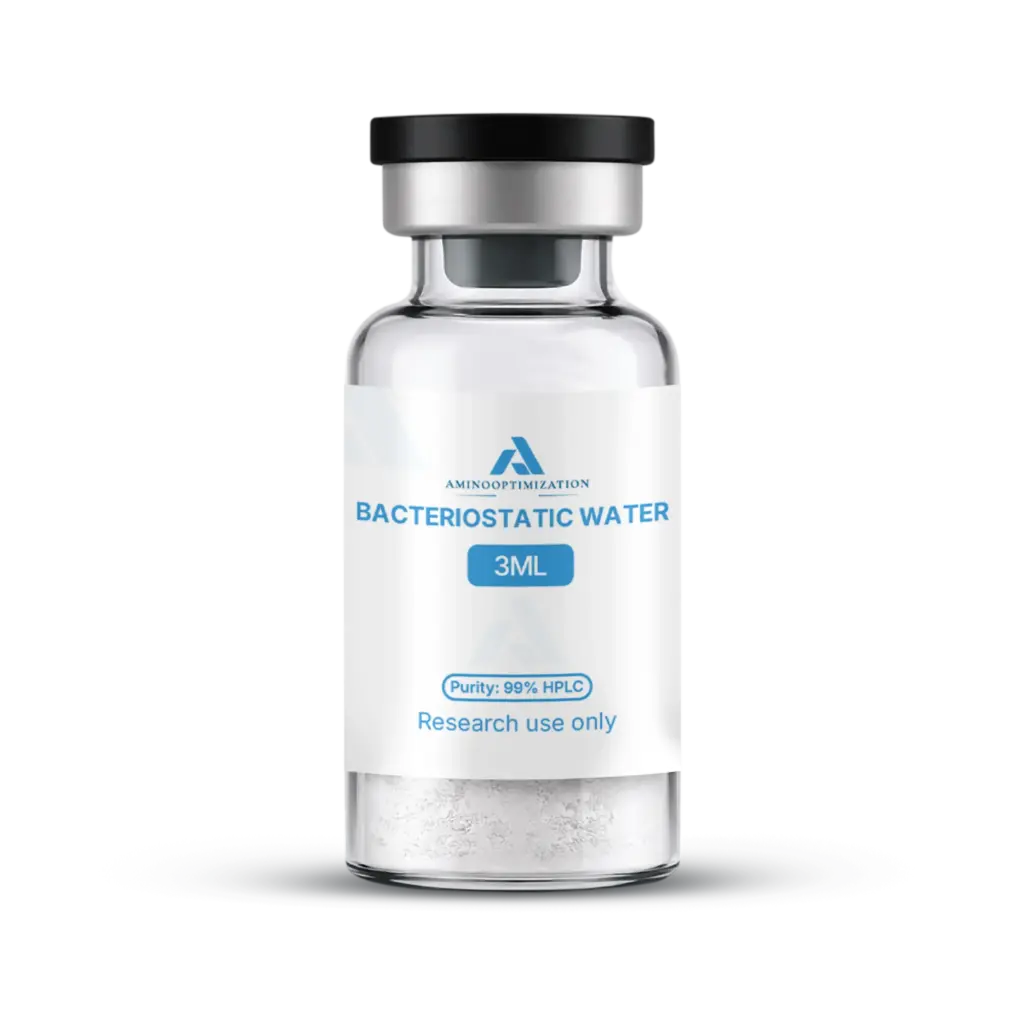
Lyophilised peptide requires reconstitution with a suitable sterile diluent before use in solution. Bacteriostatic water is the diluent most commonly specified for multi-use laboratory preparations; sterile water is typical for single-use work. Because both components of this blend are supplied together in one vial, a single reconstitution step dissolves both at once.
Direct the diluent stream against the inner vial wall rather than onto the powder, and let the material dissolve without agitation. Peptides are susceptible to shear stress — do not shake the vial. Swirl gently if needed; expect full dissolution within a few minutes at room temperature.
Working concentration depends on how much diluent is added to a given vial mass. Our peptide reconstitution calculator computes the resulting concentration for any combination of vial size and diluent volume.
Storage and stability
Before reconstitution: store the sealed vial in a freezer at -20 °C, protected from light. Lyophilised peptide is comparatively stable in this state, and brief shipping excursions to ambient temperature are normal and unlikely to compromise a properly lyophilised product.
After reconstitution: refrigerate at 2–8 °C and protect from light. Reconstituted peptide in solution — for both components of the blend — is materially less stable than the dry powder. Avoid repeated freeze-thaw cycles, a well-documented cause of aggregation and loss of measurable potency; aliquot instead if repeated sampling is required.
Inspect solutions before use. Cloudiness, visible particulate, or discolouration indicate the material should not be relied upon for quantitative work.
Certificate of Analysis
Every lot is tested by high-performance liquid chromatography, and the purity figure above refers to the specific lot supplied, not a generic specification. A Certificate of Analysis is available on request, including before purchase if your protocol requires it.
Purity by HPLC describes the proportion of target peptide content relative to detectable related substances. It is a statement about the material as manufactured and tested. It is expressly not a representation that the material is suitable for any use in humans or animals.
Handling and safety
Handle in accordance with good laboratory practice. Use appropriate personal protective equipment, work in a suitable containment environment, and dispose of material and consumables per your institution’s requirements and applicable local regulation. Anyone with access to this material should understand it is not for human or veterinary use.
Frequently asked questions
What is the difference between CJC-1295 (No DAC) and Ipamorelin?
They act on different receptors: CJC-1295 (No DAC) is a GHRH analogue engaging the growth-hormone-releasing hormone receptor, while Ipamorelin is a pentapeptide engaging the growth hormone secretagogue receptor (GHS-R1a). Researchers pair the two because the pathways are distinct.
Why are the two peptides supplied together in one vial?
Combining a GHRH-receptor agonist with a GHS-R agonist is a common study design choice when the variable under investigation is the interaction between two signalling pathways, rather than either one alone.
Is CJC-1295 (No DAC) + Ipamorelin approved in Canada?
No. This blend has not been evaluated or authorised by Health Canada, the FDA, or any comparable regulatory authority. It carries no DIN or NPN, its safety and efficacy for human use have not been assessed, and it is supplied for laboratory research only.
How much diluent should be used?
That depends on the working concentration your protocol requires. Use the reconstitution calculator to work out the resulting concentration for your vial size.
How long is reconstituted material usable?
Stability in solution is shorter than in lyophilised form and depends on diluent, temperature and handling. Refrigerate at 2–8 °C, protect from light, avoid freeze-thaw cycling, and validate stability under your own storage conditions if your work depends on it.
Research use only
This product is supplied solely for laboratory and scientific research. It is not a drug, food, cosmetic, or medical device, and it must not be administered to humans or animals. Nothing on this page is medical advice or a therapeutic claim. Full terms are set out in our Research Use Only Disclaimer.
Reviews
There are no reviews yet.