
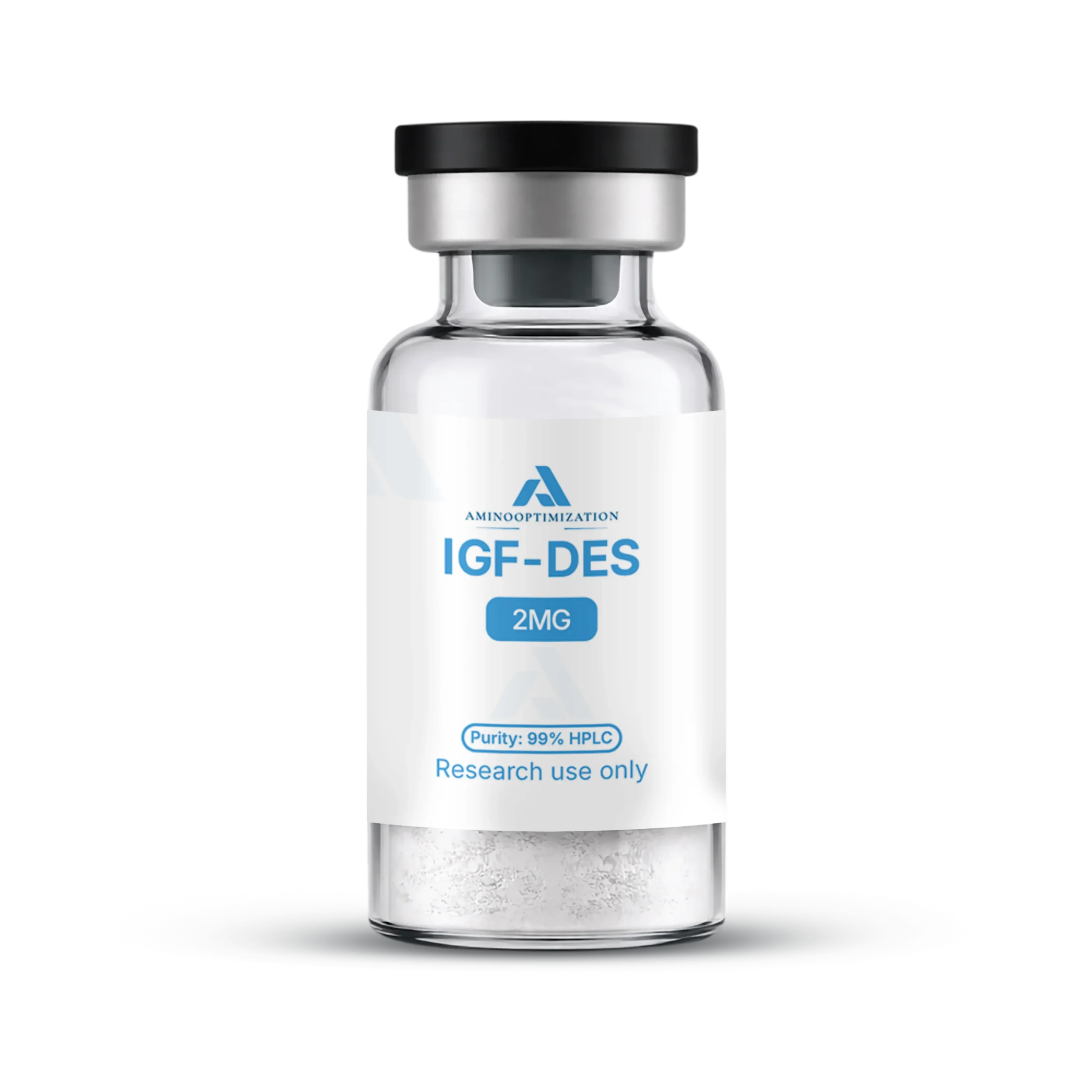
IGF-1 DES (Des(1-3)IGF-1), also referred to in the literature as IGF-DES, is a truncated analogue of insulin-like growth factor 1 lacking the first three residues — glycine, proline, and glutamate — from the native N-terminus. AminoOptimization Group supplies it as a lyophilised research powder in a 2 mg presentation, tested to 99% purity by HPLC, with a Certificate of Analysis available for the lot supplied. This material is offered strictly for laboratory research use. It is not a drug, and it is not for human or veterinary use.
What is IGF-DES?
Insulin-like growth factor 1 is a 70-residue single-chain polypeptide structurally homologous to proinsulin, stabilised by three intramolecular disulfide bonds and organised into B, C, A, and D domains. It engages the IGF-1 receptor, a receptor tyrosine kinase, and to a lesser extent the insulin receptor, initiating downstream signalling cascades studied extensively in cell biology. Des(1-3)IGF-1 removes the first three amino acids of that native sequence, producing a 67-residue analogue.
The truncated N-terminus is the segment of IGF-1 principally responsible for high-affinity binding to the IGF binding proteins (IGFBPs), a family of six circulating carrier proteins that sequester IGF-1 and regulate its availability to the receptor. Published binding studies report that removing residues 1–3 reduces IGFBP affinity substantially while leaving IGF-1 receptor affinity comparatively intact, which is why this analogue is used in vitro as a tool for isolating receptor-mediated signalling from IGFBP-modulated availability.
Des(1-3)IGF-1 is one of several N-terminally modified IGF-1 analogues examined in the literature alongside variants such as LR3 IGF-1, which instead extends the N-terminus with a 13-residue fusion peptide and an Arg3 substitution. Where LR3 IGF-1 achieves reduced IGFBP binding through extension, Des(1-3)IGF-1 achieves a related effect through deletion — a distinction that recurs in comparative study designs examining how N-terminal architecture governs IGFBP interaction and in vitro stability.
Specifications
- Compound: IGF-DES / Des(1-3)IGF-1 (Insulin-like Growth Factor-1, Des(1-3))
- CAS number: 112603-35-7
- Molecular formula: C319H501N91O96S7
- Molecular weight: 7371.48 g/mol
- Purity: 99% by HPLC
- Presentation: Lyophilised powder, sealed vial
- Available sizes: 2 mg
- Physical form: White to off-white powder
- Classification: Research peptide — not for human or veterinary use
Research context
Published research on Des(1-3)IGF-1 centres on structure-activity relationships within the IGF axis: specifically, which residues of IGF-1 are required for IGFBP recognition and which are required for IGF-1 receptor engagement. Because the two functions can be separated by this single truncation, the analogue features in binding assays designed to isolate receptor-mediated signalling from the modulating effect of IGFBP sequestration.
In cell culture systems, Des(1-3)IGF-1 is used to examine activation of downstream pathways associated with IGF-1 receptor signalling, including PI3K/Akt and MAPK/ERK cascades that overlap in part with insulin receptor signalling. Comparative study designs that run Des(1-3)IGF-1 alongside full-length IGF-1 and other N-terminally modified analogues investigate how differing IGFBP affinities alter ligand availability and observed potency across assay conditions.
None of this literature establishes safety or efficacy for use in humans. It is provided as research context only.
Reconstitution
Lyophilised peptide requires reconstitution with a suitable sterile diluent before use in solution. Bacteriostatic water is the diluent most commonly specified for multi-use laboratory preparations; sterile water is typical for single-use work.
Direct the diluent stream against the inner wall of the vial rather than onto the powder itself, and allow the material to dissolve without agitation. Peptides are susceptible to shear stress — do not shake the vial. Swirl gently if needed, and expect full dissolution within a few minutes at room temperature.
Working concentration is a function of how much diluent you add to a given vial mass. Our peptide reconstitution calculator computes the resulting concentration for any combination of vial size and diluent volume.
Storage and stability
Before reconstitution: store the sealed vial in a freezer at -20 °C, protected from light. Lyophilised peptide is comparatively stable in this state. Brief excursions to ambient temperature during shipping are normal and are not expected to compromise a properly lyophilised product.
After reconstitution: refrigerate at 2–8 °C and protect from light. Reconstituted peptide in solution is materially less stable than the dry powder. Avoid repeated freeze-thaw cycles, which are a well-documented cause of aggregation and loss of measurable potency — aliquot instead if repeated sampling is required.
Inspect solutions before use. Cloudiness, visible particulate, or discolouration indicate the material should not be relied upon for quantitative work.
Certificate of Analysis
Every lot is tested by high-performance liquid chromatography, and the purity figure shown above refers to analytical results for the specific lot supplied — not to a generic specification. A Certificate of Analysis is available on request, and we will provide lot-specific documentation before purchase if your protocol requires it.
Purity by HPLC describes the proportion of the target peptide relative to detectable related substances. It is a statement about the material as manufactured and tested. It is expressly not a representation that the material is suitable for any use in humans or animals.
Handling and safety
Handle in accordance with good laboratory practice. Use appropriate personal protective equipment, work in a suitable containment environment, and dispose of material and consumables according to your institution’s requirements and applicable local regulation. Anyone with access to this material should understand that it is not for human or veterinary use.
Frequently asked questions
What is the difference between IGF-DES and full-length IGF-1?
IGF-DES lacks the first three amino acids of native IGF-1. That truncation substantially reduces binding to IGF binding proteins while leaving IGF-1 receptor affinity largely intact, which is why researchers use it to study receptor-mediated signalling separately from IGFBP-modulated availability.
Is IGF-DES approved in Canada?
No. This compound has not been evaluated or authorised by Health Canada, the FDA, or any comparable regulatory authority. It carries no DIN or NPN, its safety and efficacy for human use have not been assessed, and it is supplied for laboratory research only.
How much diluent should be used?
That depends on the working concentration your protocol requires. Use the reconstitution calculator to work out the resulting concentration for your vial size.
How long is reconstituted material usable?
Stability in solution is shorter than in lyophilised form and depends on diluent, temperature, and handling. Refrigerate at 2–8 °C, protect from light, avoid freeze-thaw cycling, and validate stability for your own storage conditions if your work depends on it.
Do you provide a Certificate of Analysis?
Yes — lot-specific, available on request, including before purchase.
Research use only
This product is supplied solely for laboratory and scientific research. It is not a drug, food, cosmetic, or medical device, and it must not be administered to humans or animals. Nothing on this page is medical advice or a therapeutic claim. Full terms are set out in our Research Use Only Disclaimer.
Reviews
There are no reviews yet.