
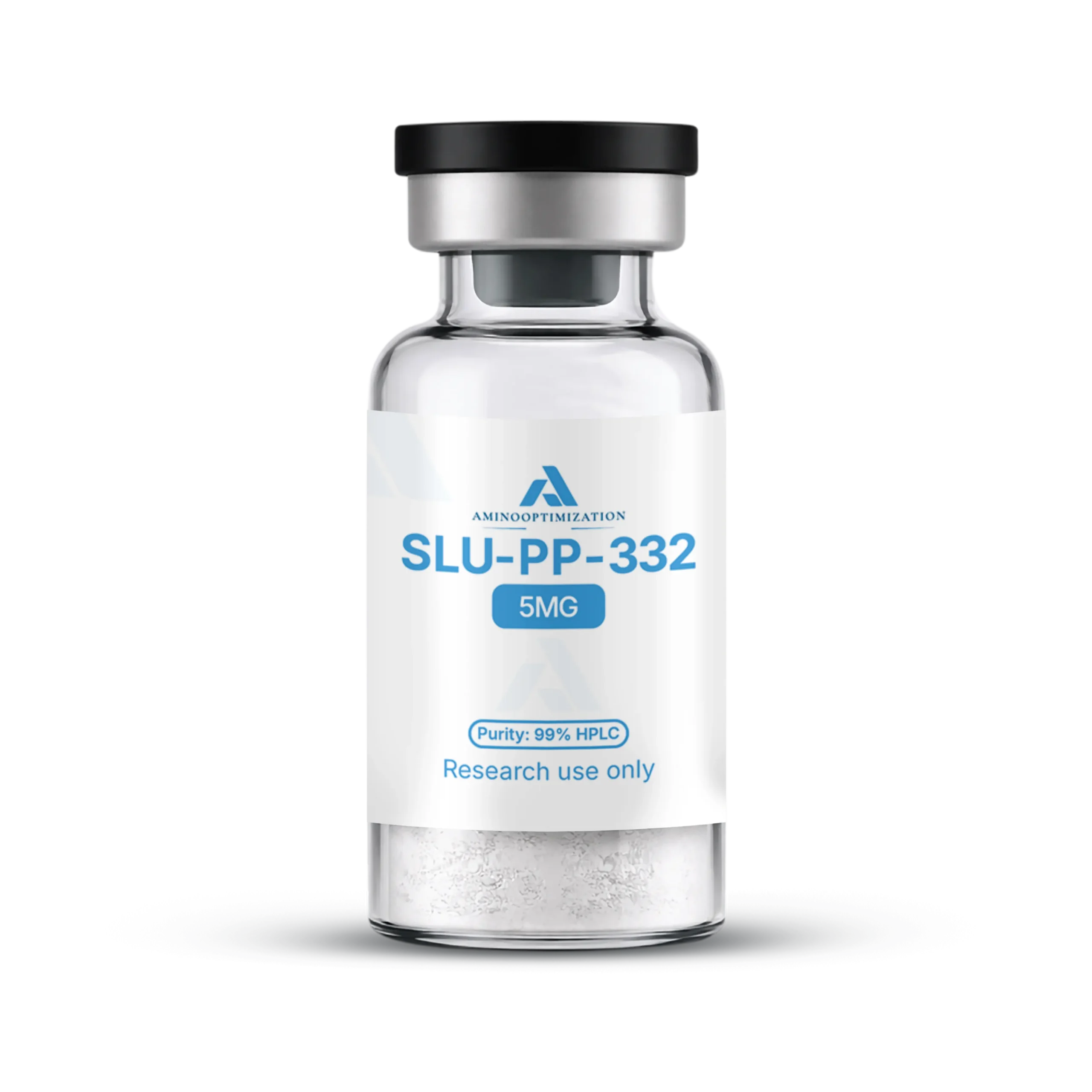
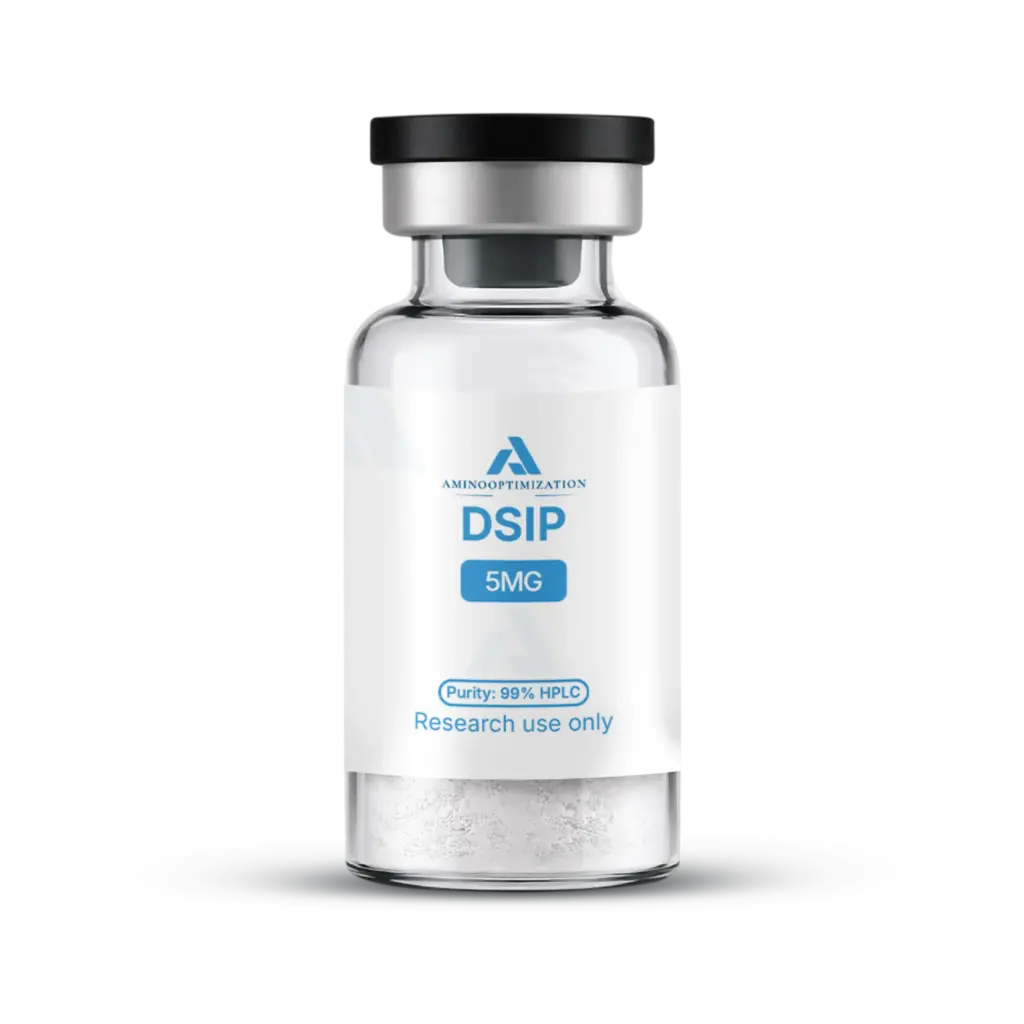
SLU-PP-332 is a synthetic small-molecule agonist of the estrogen-related receptor (ERR) family of nuclear receptors, first described in medicinal chemistry work carried out at Saint Louis University, from which its designation derives. AminoOptimization Group supplies it as a lyophilised research powder in a 5 mg presentation, tested to 99% purity by HPLC, with a Certificate of Analysis available for the lot supplied. This material is offered strictly for laboratory research use. It is not a drug, and it is not for human or veterinary use.
What is SLU-PP-332?
SLU-PP-332 acts on the estrogen-related receptor subfamily — ERRα, ERRβ, and ERRγ (NR3B1–3). Despite the name, these receptors do not bind estrogen or any related endogenous steroid; they are classified in the literature as orphan nuclear receptors because no confirmed endogenous ligand has been identified for them. Under basal conditions their transcriptional activity is described as largely constitutive, governed by coactivator availability — most notably PGC-1α — rather than by ligand binding in the way most nuclear receptors are regulated. SLU-PP-332 was developed as a tool compound capable of engaging the ERR ligand-binding domain directly, giving researchers a way to activate the receptor family pharmacologically, independent of upstream coactivator expression.
Structurally, SLU-PP-332 (C18H14N2O2, molecular weight 290.32 g/mol) is a heterocyclic synthetic compound unrelated to peptide or steroidal ligands acting at other hormone or growth-factor receptors. It is characterised in published work as a pan-ERR agonist, meaning it engages all three ERR subtypes rather than a single isoform. This distinguishes it from earlier, isoform-selective ERR ligands used as pharmacological probes, which were developed to isolate the contribution of one subtype at a time.
Because ERRs sit downstream of, and interact extensively with, PGC-1α-driven transcriptional programs governing mitochondrial biogenesis and oxidative metabolism, pan-ERR agonism is used experimentally to interrogate that network directly, without first inducing PGC-1α expression through an upstream stimulus. This positions SLU-PP-332 as a distinct research tool relative to compounds that act earlier in the same pathway.
Specifications
- Compound: SLU-PP-332
- CAS number: 303760-60-3
- Molecular formula: C18H14N2O2
- Molecular weight: 290.32 g/mol
- Purity: 99% by HPLC
- Presentation: Lyophilised powder, sealed vial
- Available sizes: 5 mg
- Physical form: White to off-white powder
- Classification: Research peptide — not for human or veterinary use
Research context
Published research on SLU-PP-332 centres on the transcriptional consequences of pan-ERR activation in skeletal muscle. In cultured myotubes and in mouse skeletal muscle, pan-ERR agonism has been examined for its effect on genes governing mitochondrial biogenesis, oxidative phosphorylation capacity, and fibre-type composition, with reported findings describing a shift in gene expression toward a profile resembling that seen with endurance exercise training in the same model systems.
The compound is also studied for what it reveals about ERR pathway biology more broadly, including its interaction with PGC-1α coactivator signalling, and its use alongside other mitochondrial and metabolic research tools to dissect which components of the oxidative-metabolism transcriptional program depend on direct ERR engagement rather than upstream signalling. Some published work extends this line of investigation to metabolic tissues beyond skeletal muscle, examining pan-ERR agonism in rodent models of diet-induced metabolic dysfunction.
None of this literature establishes safety or efficacy for use in humans. It is provided as research context only.
Reconstitution
Lyophilised research powder requires reconstitution with a suitable sterile diluent before use in solution. Bacteriostatic water is the diluent most commonly specified for multi-use laboratory preparations; sterile water is typical for single-use work.
Direct the diluent stream against the inner wall of the vial rather than onto the powder itself, and allow the material to dissolve without agitation. Do not shake the vial. Swirl gently if needed, and expect dissolution within a few minutes at room temperature.
Working concentration is a function of how much diluent is added to a given vial mass. Our peptide reconstitution calculator computes the resulting concentration for any combination of vial size and diluent volume.
Storage and stability
Before reconstitution: store the sealed vial in a freezer at -20 °C, protected from light. Lyophilised material in this state is comparatively stable. Brief excursions to ambient temperature during shipping are normal and are not expected to compromise a properly lyophilised product.
After reconstitution: refrigerate at 2–8 °C and protect from light. Material in solution is materially less stable than the dry powder. Avoid repeated freeze-thaw cycles, which are a well-documented cause of degradation — aliquot instead if repeated sampling is required.
Inspect solutions before use. Cloudiness, visible particulate, or discolouration indicate the material should not be relied upon for quantitative work.
Certificate of Analysis
Every lot is tested by high-performance liquid chromatography, and the purity figure shown above refers to analytical results for the specific lot supplied, not to a generic specification. A Certificate of Analysis is available on request, and we will provide lot-specific documentation before purchase if your protocol requires it.
Purity by HPLC describes the proportion of the target compound relative to detectable related substances. It is a statement about the material as manufactured and tested. It is expressly not a representation that the material is suitable for any use in humans or animals.
Handling and safety
Handle in accordance with good laboratory practice. Use appropriate personal protective equipment, work in a suitable containment environment, and dispose of material and consumables according to your institution’s requirements and applicable local regulation. Anyone with access to this material should understand that it is not for human or veterinary use.
Frequently asked questions
How does SLU-PP-332 differ from other ERR-targeting research compounds?
Earlier isoform-selective ERR ligands used in the literature were developed to isolate the contribution of a single receptor subtype. SLU-PP-332 is characterised as a pan-agonist that engages ERRα, ERRβ, and ERRγ together, which is used in study designs where subtype-specific contribution is not the variable under investigation.
Is SLU-PP-332 approved in Canada?
No. This compound has not been evaluated or authorised by Health Canada, the FDA, or any comparable regulatory authority. It carries no DIN or NPN, its safety and efficacy for human use have not been assessed, and it is supplied for laboratory research only.
How much diluent should be used?
That depends on the working concentration a given protocol requires. Use the reconstitution calculator to work out the resulting concentration for your vial size.
How long is reconstituted material usable?
Stability in solution is shorter than in lyophilised form and depends on diluent, temperature, and handling. Refrigerate at 2–8 °C, protect from light, avoid freeze-thaw cycling, and validate stability for your own storage conditions if your work depends on it.
Do you provide a Certificate of Analysis?
Yes — lot-specific, available on request, including before purchase.
Research use only
This product is supplied solely for laboratory and scientific research. It is not a drug, food, cosmetic, or medical device, and it must not be administered to humans or animals. Nothing on this page is medical advice or a therapeutic claim. Full terms are set out in our Research Use Only Disclaimer.
Reviews
There are no reviews yet.