
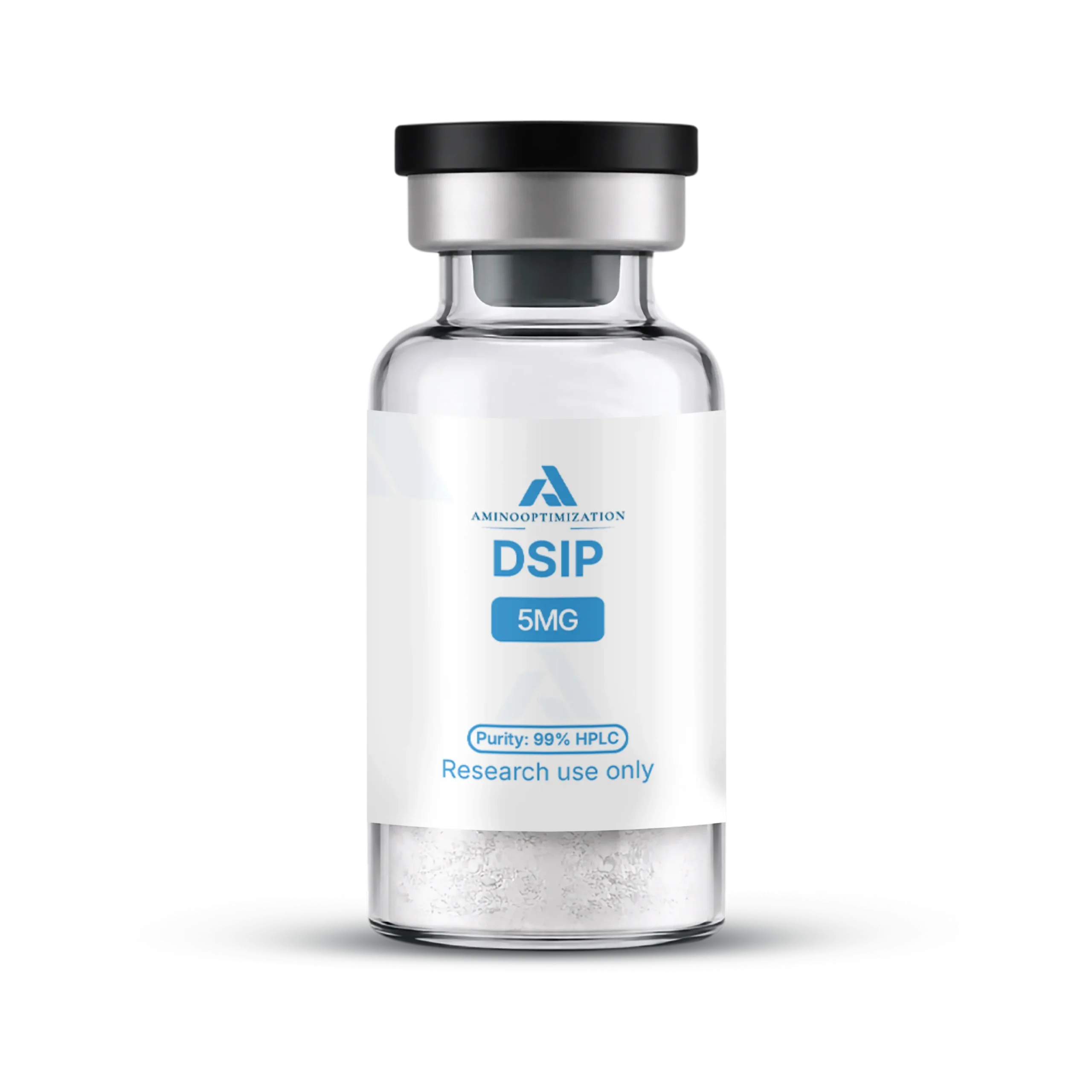
DSIP, or delta sleep-inducing peptide, is a nonapeptide with the sequence Trp-Ala-Gly-Gly-Asp-Ala-Ser-Gly-Glu, first described in the literature in 1977. AminoOptimization Group supplies it as a lyophilised research powder in 5 mg and 10 mg presentations, tested to 99% purity by HPLC, with a Certificate of Analysis available for the lot supplied. This material is offered strictly for laboratory research use. It is not a drug, and it is not for human or veterinary use.
What is DSIP?
DSIP is one of the shorter and structurally simpler peptides in a typical research catalogue: a linear nonapeptide with a free (non-amidated) C-terminal glutamate, no cysteine residues, and therefore no disulfide bridging. Its composition is dominated by small, flexible residues — three glycines and two alanines — bracketing a single tryptophan near the N-terminus and two acidic residues, aspartate and glutamate, that give the molecule a net negative charge at physiological pH. Reported nuclear magnetic resonance and circular dichroism work describes it as lacking a fixed secondary structure in aqueous solution, consistent with a short, glycine-rich backbone.
The compound’s name reflects the assay in which it was isolated rather than a demonstrated action in any species. Schoenenberger and Monnier described it in 1977 following cross-circulation studies in rabbits, in which dialysed venous blood from an animal exhibiting delta-wave electroencephalographic activity was found to transfer that EEG pattern to a second animal. The nonapeptide responsible for the transferable effect in that model was subsequently sequenced and named for the wave band under study.
DSIP is frequently discussed alongside better-characterised research peptides such as GHRH and GHS-R analogues, but the comparison highlights a distinguishing gap rather than a similarity: those compounds act at defined pituitary receptors, while no dedicated DSIP receptor has been conclusively identified in the published literature. Its mechanism of action is still described in review articles as unresolved, which is part of why it continues to appear in comparative and mechanistic study designs decades after its initial isolation.
Specifications
- Compound: DSIP (Delta Sleep-Inducing Peptide)
- CAS number: 62568-57-4
- Molecular formula: C35H48N10O15
- Molecular weight: 848.81 g/mol
- Purity: 99% by HPLC
- Presentation: Lyophilised powder, sealed vial
- Available sizes: 5 mg, 10 mg
- Physical form: White to off-white powder
- Classification: Research peptide — not for human or veterinary use
Research context
Published research on DSIP centres on electroencephalographic sleep architecture in animal models, particularly the delta-wave (slow-wave) band from which the compound takes its name. Study designs in this area typically record EEG output in rodent or feline models following central or peripheral administration and compare the resulting wave patterns to control conditions, using the peptide as a tool to probe how slow-wave activity is generated and regulated rather than to characterise a therapeutic effect.
A second body of literature examines DSIP in the context of the hypothalamic-pituitary-adrenal axis, including its reported interaction with corticotropin-releasing factor signalling and its use in stress-response and opioid- or ethanol-withdrawal paradigms in laboratory animals. Because a specific receptor has not been isolated, much of this work is framed around observed downstream effects on hormone secretion and behaviour in the model system studied, rather than a defined binding mechanism.
None of this literature establishes safety or efficacy for use in humans. It is provided as research context only.
Reconstitution
As with other lyophilised peptides, DSIP must be brought into solution with a sterile diluent before use in an experimental protocol. Bacteriostatic water is generally specified where a preparation will be accessed more than once; sterile water without a preservative is more typical for single-use preparations.
Add the diluent by directing the stream against the interior wall of the vial rather than onto the powder, then allow the material to go into solution without agitation. Shaking introduces shear stress that can degrade peptide structure; a gentle swirl is sufficient. Given its small size and low aromatic content, DSIP typically dissolves readily at room temperature.
The concentration of the resulting solution depends on how much diluent is added to a given vial. Our peptide reconstitution calculator computes the resulting concentration for any combination of vial size and diluent volume.
Storage and stability
Before reconstitution: keep the sealed vial in a freezer at -20 °C, protected from light. In lyophilised form, DSIP is comparatively stable, and brief temperature excursions during shipping are not expected to compromise a properly freeze-dried product.
After reconstitution: store at 2–8 °C and protect from light. Peptide in solution is materially less stable than the dry powder, and repeated freeze-thaw cycling is a documented cause of aggregation and loss of measurable material. Where a protocol requires repeated sampling over time, aliquoting is preferable to refreezing and thawing a single stock.
Inspect any solution before use. Cloudiness, particulate matter, or discolouration are indications that the material should not be relied upon for quantitative work.
Certificate of Analysis
Each lot is analysed by high-performance liquid chromatography, and the purity figure listed above reflects the specific lot supplied rather than a general specification. A Certificate of Analysis is available on request, and lot-specific documentation can be provided before purchase if your protocol requires it.
The HPLC purity figure describes the proportion of target peptide relative to detectable related substances in the material as manufactured and tested. It is not a representation, express or implied, that the material is suitable for use in humans or animals.
Handling and safety
Handle this material under good laboratory practice. Use appropriate personal protective equipment, work within a suitable containment environment, and dispose of the material and any associated consumables in accordance with your institution’s procedures and applicable local regulation. Anyone handling this compound should be aware that it is not for human or veterinary use.
Frequently asked questions
What distinguishes DSIP from other neuropeptides studied in sleep research?
Unlike growth hormone secretagogues or GHRH analogues, DSIP has no conclusively identified receptor. Its mechanism is still described as unresolved in the literature, and study designs generally examine downstream EEG or hormonal readouts in a model system rather than a defined receptor-binding event.
Is DSIP approved in Canada?
No. This compound has not been evaluated or authorised by Health Canada, the FDA, or any comparable regulatory authority. It carries no DIN or NPN, its safety and efficacy for human use have not been assessed, and it is supplied for laboratory research only.
How much diluent should be used to reconstitute DSIP?
This depends on the working concentration your protocol calls for. Use the reconstitution calculator to work out the resulting concentration for a given vial size.
How long is reconstituted DSIP stable?
Stability in solution is lower than in lyophilised form and depends on diluent, storage temperature, and handling. Refrigerate at 2–8 °C, protect from light, avoid freeze-thaw cycling, and validate stability under your own storage conditions if your work depends on it.
Do you provide a Certificate of Analysis?
Yes — lot-specific, available on request, including before purchase.
Research use only
This product is supplied solely for laboratory and scientific research. It is not a drug, food, cosmetic, or medical device, and it must not be administered to humans or animals. Nothing on this page is medical advice or a therapeutic claim. Full terms are set out in our Research Use Only Disclaimer.
Reviews
There are no reviews yet.